 Get a Quote

Server Room Fire Suppression: Choosing the Right System for Data Centers
Server Room Fire Suppression: Choosing the Right System for Data Centers
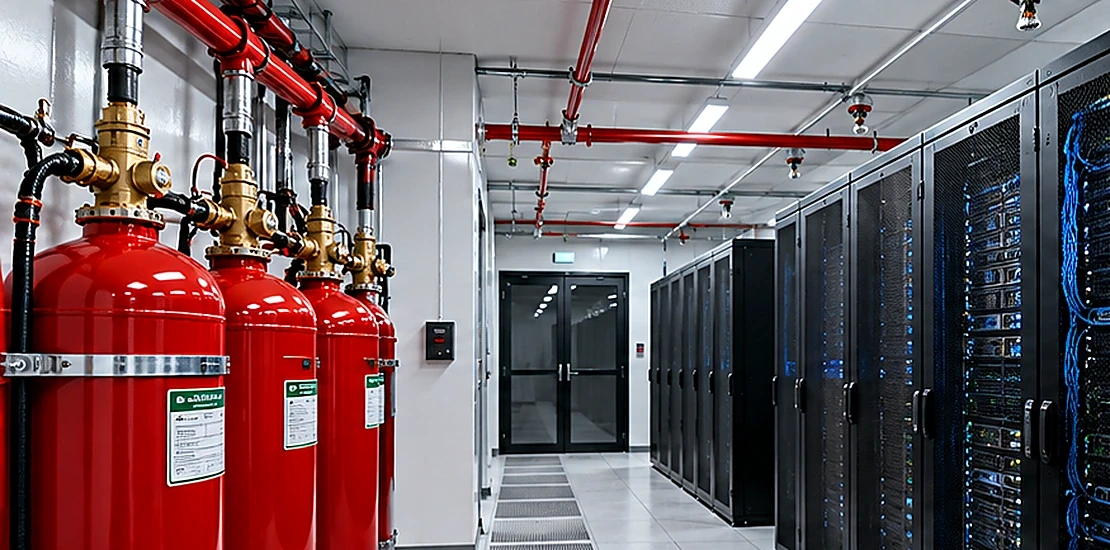
For many organizations, the server room is the heart of the business. Payments, customer data, communications, security systems, and daily operations all depend on it. A small electrical fault in a power supply or a battery can turn into a fire that stops everything within minutes. And if the fire is fought with the wrong method, the damage from water or powder can be almost as severe as the fire itself. Choosing the right server room fire suppression system is therefore not only a safety decision, but a business continuity decision.
This guide compares the main server room fire suppression options, including clean agents, inert gases, condensed aerosol, pre-action sprinklers, and very early smoke detection, and explains how to choose the right combination for a server room, telecom room, or data center in Saudi Arabia.
Why Server Room Fire Suppression Needs Special Planning
Server rooms combine high electrical loads, dense cabling, UPS batteries, and continuous cooling in a closed space. Fires in these rooms usually start small and smoldering, often inside equipment or cable trays, and produce smoke long before visible flames appear. At the same time, the equipment is extremely sensitive to water, corrosive smoke, and residue.
The cost of a fire is rarely limited to replacing hardware. Downtime, lost transactions, data recovery, contractual penalties, and reputational damage can far exceed the value of the equipment. That is why effective server room fire suppression aims to detect fires very early and extinguish them without harming the equipment or interrupting more operations than necessary.
Detection Comes First: Very Early Warning
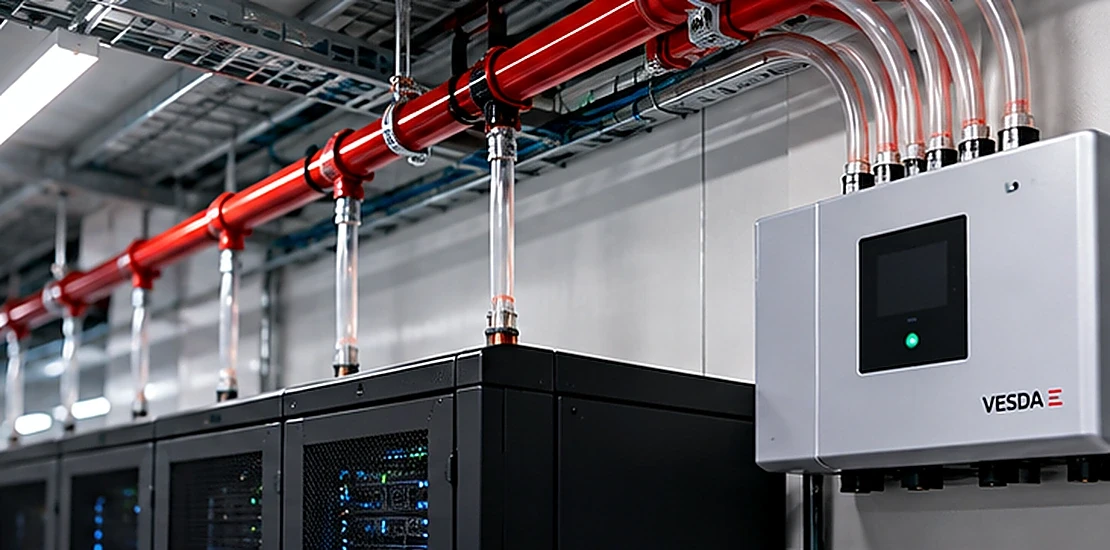
The best server room fire suppression strategy starts with detection. Aspirating smoke detection systems, often known by the brand name VESDA, continuously draw air samples through a pipe network and analyze them with a highly sensitive detector. They can identify overheating cables or components at the earliest stage, giving staff time to investigate and isolate the faulty equipment before a fire develops.
For automatic release of a suppression system, designers usually use two independent detection signals, known as cross-zoned or coincidence detection, so the system discharges only when the fire is confirmed. This approach greatly reduces the risk of accidental discharge, a common concern discussed in our article on fire alarm false alarms.
The Main Server Room Fire Suppression Options
There is no single best system for every room. Each server room fire suppression option has its own strengths, limitations, and costs.
Clean Agent Systems: FM-200 and FK-5-1-12
In server room fire suppression, clean agents are the most familiar option. They are gaseous extinguishing agents that leave no residue and do not conduct electricity, making them a traditional choice for server rooms. They are stored as a liquid in cylinders and discharged within seconds through a pipe network and nozzles, reaching the design concentration quickly.
- FM-200 (HFC-227ea) works mainly by absorbing heat from the fire. It has been widely used for decades and requires relatively compact storage. However, it has a high global warming potential and is subject to increasing environmental restrictions in many markets, which may affect future availability and recharge costs. Our detailed guide on the FM200 fire suppression system explains how it works.
- FK-5-1-12, a fluorinated ketone agent widely known in the past under the Novec 1230 brand, has a very low global warming potential and a short atmospheric lifetime. It is now produced by several manufacturers and has become a popular choice for new projects seeking a more sustainable clean agent.
Both agents are designed for use in normally occupied spaces at their design concentrations when applied according to the relevant standards, such as NFPA 2001, but evacuation before discharge remains the safest practice.
Inert Gas Systems
Inert gas server room fire suppression systems use naturally occurring gases such as nitrogen, argon, or a blend of nitrogen, argon, and carbon dioxide (for example IG-541, IG-55, and IG-100). They reduce the oxygen level in the room to a point where combustion cannot continue, typically to around 12 to 15 percent, a level designed to allow people to evacuate safely.
Inert gases have zero global warming potential and leave no residue. However, they require more cylinders and therefore more storage space, and rooms need properly sized pressure relief vents. They are a strong option for larger data halls and organizations with strict environmental policies.
Condensed Aerosol Systems
For compact rooms, condensed aerosol is a cost-effective server room fire suppression option. Condensed aerosol systems, such as DSPA technology, generate a very fine aerosol that interrupts the chemical reaction of the fire. The units are compact, require no pipe network or heavy cylinders, and are typically faster and more economical to install, which makes them attractive for small server rooms, telecom rooms, network cabinets, and electrical rooms.
Aerosol systems are generally used in normally unoccupied spaces, and the fine particles may require cleaning after discharge. For a closer comparison of this technology with conventional systems, see our article on DSPA vs traditional fire suppression systems, and our team can advise on where aerosol fire suppression systems are the best fit.
Pre-Action Sprinklers
In server room fire suppression, water is usually a backup rather than the first line. Pre-action sprinklers keep the pipes dry until the detection system confirms a fire, and water flows only through the sprinkler heads that open from heat. Double-interlock designs require both detection and a sprinkler head to operate before water enters the pipes, reducing the risk of accidental water damage.
In many buildings, codes or insurers require sprinklers throughout, including server rooms. In these cases, a pre-action fire sprinkler system is often combined with a gaseous system, where the gas extinguishes the fire early and the sprinklers act as a backup for building protection.
What About CO2 and Water Mist?
Carbon dioxide total flooding systems are effective but dangerous to people at extinguishing concentrations, so they are generally avoided in rooms that are normally occupied. Water mist systems use very fine droplets to cool fires with limited water quantities and can be considered in some IT environments, but they still introduce moisture, so their use should be evaluated carefully with the equipment owner and insurer.
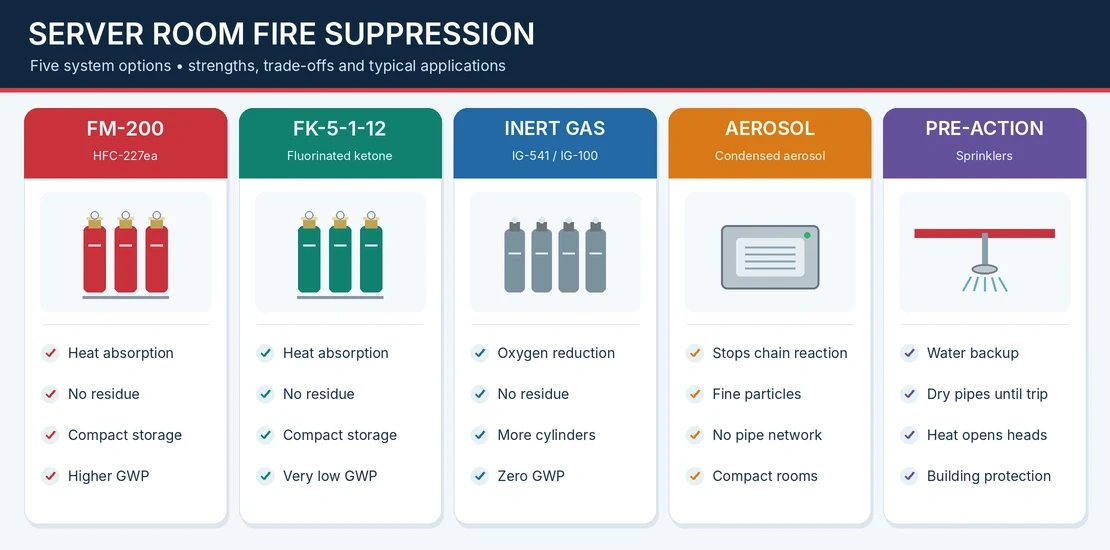
Server Room Fire Suppression Options Compared
| System | How It Works | Residue | Space Needed | Typical Use |
| FM-200 | Absorbs heat | None | Low to medium | Existing installations, small to medium rooms |
| FK-5-1-12 | Absorbs heat | None | Low to medium | New server rooms and data centers |
| Inert gas | Reduces oxygen | None | High (more cylinders) | Large data halls, zero-GWP policies |
| Condensed aerosol | Interrupts combustion chemistry | Fine particles | Very low | Small unoccupied rooms, cabinets, telecom rooms |
| Pre-action sprinklers | Water after confirmed fire | Water | Pipe network | Building protection and backup |
| Aspirating detection | Very early smoke detection | None | Small pipe network | All server rooms as early warning |
How to Choose the Right Server Room Fire Suppression System
Selecting the right server room fire suppression solution depends on several practical factors:
- Room size and layout. Small rooms may suit aerosol or compact clean agent systems, while large halls may favor inert gas or engineered clean agent systems.
- Rooms where staff work regularly need agents suitable for occupied spaces and clear evacuation procedures.
- Available storage space. Inert gas systems need more space for cylinders than clean agents or aerosol units.
- Room integrity. Gaseous systems depend on a well-sealed room that can hold the agent concentration long enough.
- Environmental policy. Organizations with sustainability targets often prefer FK-5-1-12 or inert gases.
- Insurance and code requirements. Some buildings require sprinklers in addition to gaseous protection.
- Total cost of ownership. Consider installation, maintenance, room sealing, and recharge costs, not only the initial price.
Room Integrity and Pressure Relief for Server Room Fire Suppression
A gaseous server room fire suppression system only works if the agent stays in the room long enough to extinguish the fire and prevent re-ignition. Standards such as NFPA 2001 require the protected enclosure to maintain the design concentration for a specified hold time, commonly at least 10 minutes. A room integrity (door fan) test verifies this by measuring air leakage. Cable penetrations, raised floors, false ceilings, and doors must be properly sealed.
At the same time, the sudden discharge of gas changes the pressure inside the room. Pressure relief vents are often required, especially for inert gas systems, to protect walls, ceilings, and doors from damage.
System Interfaces and Safety Features
- Pre-discharge alarms. Audible and visual alarms warn occupants before the agent is released.
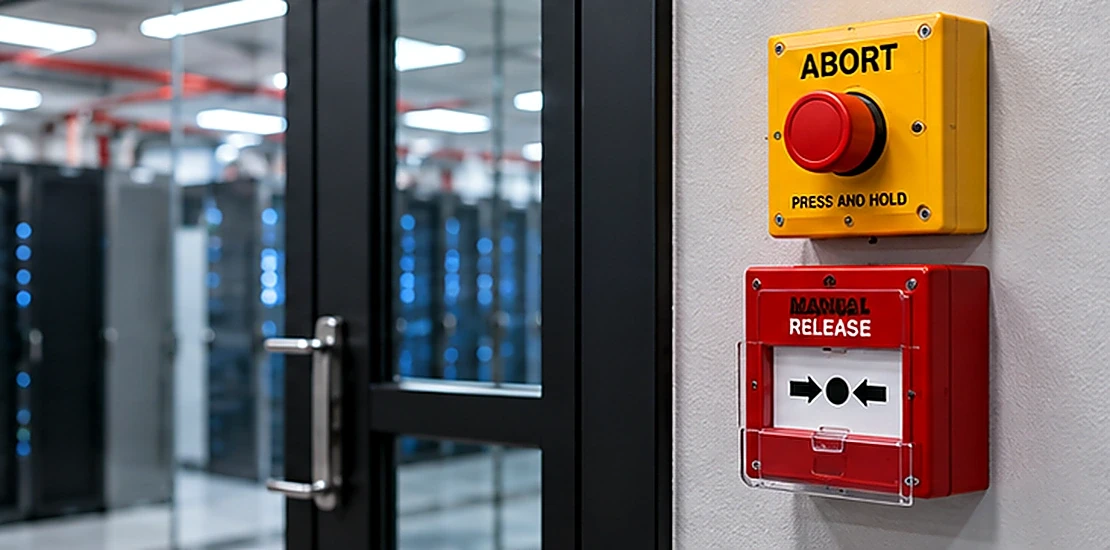
- Abort and manual release switches. Located at the exits, they allow trained staff to delay or trigger discharge.
- HVAC and damper control. Air conditioning and dampers are shut down to keep the agent in the room.
- Power shutdown where required. Some designs isolate power to equipment to remove the ignition source.
- Warning signs at the doors inform people that the room is protected by an automatic system.
- Fire alarm integration. All signals are reported to the building fire alarm and monitoring center.
Protecting UPS and Battery Rooms
A complete server room fire suppression plan must also consider power equipment. UPS systems and battery banks, especially lithium-ion batteries, introduce specific fire risks, including thermal runaway and off-gassing. Battery rooms need early detection, appropriate ventilation, and a suppression strategy designed for the battery technology in use. Electrical cabinets and distribution panels inside or near the server room can also be protected individually, an approach we will cover in our upcoming guide on electrical panel fire suppression.
Small Server Rooms and Network Cabinets
Not every business has a data center, but almost every business has a server or network cabinet. Small server rooms in offices, clinics, schools, and retail head offices are often the least protected, sometimes relying only on a ceiling smoke detector and a portable extinguisher. Compact server room fire suppression solutions, such as small clean agent units or condensed aerosol generators, can protect these rooms and cabinets without major construction, providing automatic protection at a fraction of the cost of a full engineered system.
How to Plan Server Room Fire Suppression Step by Step
- Assess the room. Measure the volume, check walls, ceilings, floors, and openings, and list the equipment and batteries inside.
- Define the risk and priorities. Identify the impact of downtime, occupancy patterns, and insurance or code requirements.
- Select detection and agent. Choose very early detection and the suppression agent that fits the room, budget, and environmental policy.
- Design and calculate. Calculate the agent quantity, nozzle locations, pipe sizes, and pressure relief based on the listed design manual.
- Seal and integrate. Seal penetrations, connect HVAC, dampers, power shutdown, and the fire alarm.
- Test and hand over. Perform a room integrity test, commission every function, train staff, and provide full documentation.
Server Room Fire Suppression in Saudi Arabia
In Saudi Arabia, server room fire suppression systems must meet Civil Defense requirements and are typically designed according to international standards such as NFPA 75 for the protection of IT equipment, NFPA 2001 for clean agent systems, and the manufacturer’s listed design manuals. The local climate adds another factor: high outdoor temperatures place heavy loads on cooling systems, and a cooling failure can raise equipment temperatures quickly. Reliable cooling, clean filters, and early detection work together to prevent overheating from becoming a fire.
Testing and Maintenance of Server Room Fire Suppression
A server room fire suppression system that has not been maintained may fail when it is needed most. Regular servicing should include checking cylinder pressure and weight, inspecting nozzles and pipework, testing detection and control panels, verifying abort and manual release functions, checking HVAC and damper interlocks, and repeating room integrity tests after any building changes. Working with a qualified maintenance and support provider keeps your server room fire suppression system ready and fully documented.
Common Server Room Fire Suppression Mistakes
- Relying on standard sprinklers only. Water can protect the building but may destroy the equipment.
- Ignoring room sealing. New cable penetrations can reduce the agent hold time below safe levels.
- Single-detector release. Releasing on one detector increases the risk of accidental discharge.
- Choosing only by initial price. Recharge costs, storage space, and future agent availability matter.
- Forgetting staff training. People must know what the pre-discharge alarm means and how to use abort switches.
Conclusion
Protecting a server room means protecting the business that depends on it. The right server room fire suppression solution combines very early detection, a suitable extinguishing agent, a well-sealed room, safe interfaces, and regular maintenance. Whether the best choice is FK-5-1-12, FM-200, inert gas, condensed aerosol, or a combination with pre-action sprinklers depends on the size, use, and risk profile of your facility. Making that decision with an experienced specialist ensures the system protects both your equipment and your operations.
Need to protect a server room or data center? The CCCO team can assess your room, compare the suitable server room fire suppression options, design and install the system, and keep it tested and maintained. Contact us today to request a site assessment.
Frequently Asked Questions
What is the best fire suppression system for a server room?
It depends on the room size, occupancy, storage space, and environmental policy. Clean agents such as FK-5-1-12, inert gases, and aerosol systems are common options, often combined with very early smoke detection.
Can sprinklers be used in a server room?
Pre-action sprinklers are often used for building protection, sometimes as a backup to a gaseous system, but standard wet sprinklers are usually avoided.
Is FM-200 still a good option?
It remains effective and widely installed, but its high global warming potential and environmental restrictions lead many new projects to consider FK-5-1-12 or inert gases.
Are clean agents safe for people?
Clean agents are designed for occupied spaces at their design concentrations when applied correctly, but evacuating before discharge is always recommended.
What is a room integrity test?
It is a test that measures air leakage to confirm the room can hold the agent concentration for the required time.
Do aerosol systems leave residue?
Condensed aerosol systems can leave fine particles that may require cleaning, which is why they are usually used in unoccupied rooms and enclosures.
How often should a server room fire suppression system be serviced?
According to the manufacturer’s guidance and applicable standards, typically with periodic inspections and regular checks of cylinders, detection, and interlocks.