 Get a Quote

Fire Hose Reel System and Fire Hydrants: Components and Installation Requirements
Fire Hose Reel System and Fire Hydrants: Components and Installation Requirements
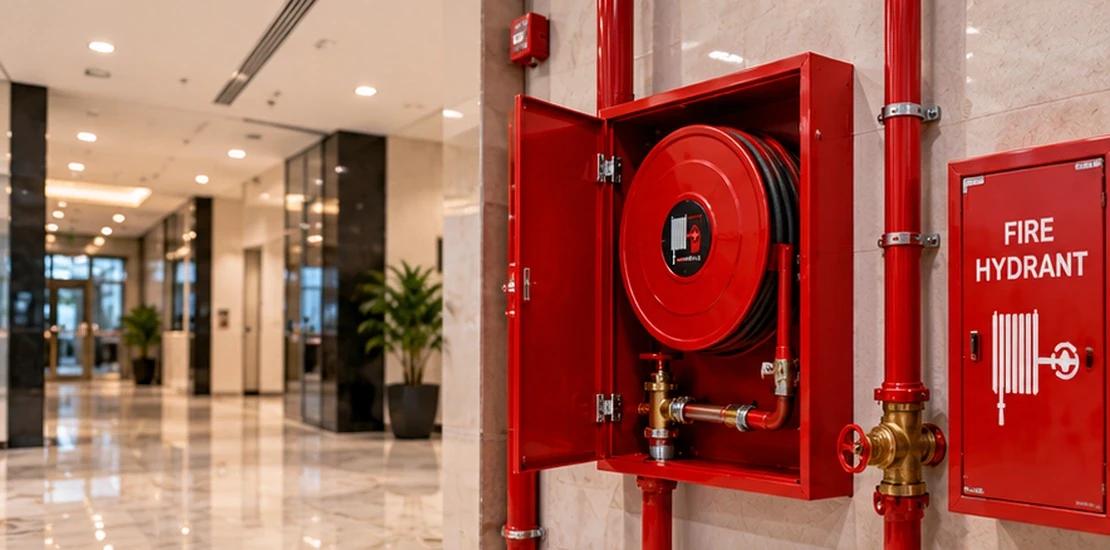
When a fire breaks out, the people nearby often have only a minute or two to act before it grows beyond control. A fire hose reel system gives them a controlled, continuous supply of water to fight a small fire safely, while fire hydrants give the Civil Defense teams the large volumes of water they need once a fire is already established. Together, these two systems form the manual firefighting backbone of almost every commercial and industrial building in Saudi Arabia.
This guide explains how a fire hose reel system and a fire hydrant system work, their main components, the difference between wet and dry standpipes, how landing valves and breeching inlets fit in, and the installation requirements facility owners should understand. Whether you are planning a new building or reviewing an existing one, understanding these systems helps you provide real, reliable firefighting capability rather than equipment that only looks compliant on the wall.
What Is a Fire Hose Reel System?
A fire hose reel system is a fixed firefighting installation that delivers water through a semi-rigid hose wound on a circular reel, ready for immediate manual use by a building’s occupants. Each reel is permanently connected to a pressurized water supply, so a person only has to open the valve, pull out the hose, and direct the jet at the fire.
Because the hose is semi-rigid, water can flow even when the hose is only partly unwound, which makes the fire hose reel system fast and simple to use without special training. It is designed as a first-aid firefighting measure for tackling small, early-stage fires before they spread, not as a replacement for fixed suppression systems or the fire brigade. A typical fire hose reel uses a 19 mm or 25 mm hose up to 30 m long, following standards such as EN 671 for fixed hose reels.
Fire Hose Reel System vs Fire Hydrants: What Is the Difference?
A fire hose reel system and a fire hydrant system are often confused because both deliver water through hoses, but they serve different users and different stages of a fire. The fire hose reel system is a light, easy-to-use tool for occupants facing a small fire. A fire hydrant system, by contrast, is built for professional firefighters who arrive with their own equipment and need large volumes of water to control a developed fire. In most buildings, both are fed from the same fire water supply, but through separate pipework sized for very different flows.
| Feature | Fire Hose Reel System | Fire Hydrant System |
| Primary user | Building occupants and trained staff | Civil Defense and professional firefighters |
| Hose and outlet size | 19 mm or 25 mm semi-rigid hose, up to 30 m | 65 mm (2.5″) landing valves and pillar hydrants |
| Flow and pressure | Low flow for first-aid firefighting | High flow for developed fires |
| When it is used | Small, early-stage fires | Established fires needing large water volumes |
| Location | Inside the building, near exits and corridors | On internal risers and around the site |
Main Components of a Fire Hose Reel System
- Hose reel drum. A circular drum that holds the coiled semi-rigid hose and swings out so the hose can be pulled in any direction.
- Semi-rigid hose. Usually 19 mm or 25 mm in diameter and up to 30 m long; it keeps its shape so water flows even when the hose is only partly unwound.
- Shut-off valve. An inlet valve that feeds water to the reel; some reels use an automatic valve that opens as the hose is pulled out.
- A control nozzle at the hose end that lets the user shut off, spray, or direct a jet at the fire.
- Guide and cabinet. A hose guide and, in many cases, a recessed or surface-mounted cabinet that protects the reel and keeps it accessible.
- Pipework connection. The branch pipe that connects the reel to the building’s wet riser or a dedicated hose reel main.
How a Fire Hose Reel Works
Using a fire hose reel system is deliberately simple so that an untrained person can act quickly. First, the user opens the shut-off valve to charge the hose with water. Next, they pull the hose off the drum and run toward the fire, keeping enough distance to stay safe. They then open the nozzle and direct the water at the base of the flames, sweeping across the burning material rather than at the tips of the fire. Finally, the nozzle is used to control the jet or spray and to shut the water off once the fire is out or if they need to retreat. The whole sequence can be carried out by one person in seconds, which is exactly why the fire hose reel system is valued as a first response tool.
Fire Hydrant Systems: Types and Components
A fire hydrant system supplies water to the fire brigade at the points where they need it most. It has two parts: an internal system of risers and landing valves inside the building, and an external network of hydrants around the site. Inside, vertical pipes called standpipes or risers carry water up through the building, with a landing valve on each floor. Outside, pillar or underground hydrants are placed along the access roads so a fire appliance can draw water close to any part of the building. The main components of a fire hydrant system include the risers or standpipes, landing valves, the breeching (fire department) inlet, external hydrants, hose cabinets with 65 mm hoses and branch pipes, and the fire water tank and pump set that feed the whole network.

Standpipe and Riser Systems: Wet vs Dry
A standpipe system is the network of vertical pipes that delivers water to the landing valves and hose outlets on every floor. There are two main arrangements. A wet riser is permanently filled with pressurized water from the tank and pumps, so firefighters have water immediately at any floor; it is used in high-rise buildings. A dry riser is normally empty and is charged only when the fire brigade pumps water into a breeching inlet at ground level; it suits mid-rise buildings where a permanent supply at height is not required. The right choice depends mainly on building height and is set by the applicable code.
| Riser Type | How It Works | Typical Use |
| Wet riser | Permanently filled with pressurized water from the tank and pumps | High-rise buildings where firefighters need water immediately at every floor |
| Dry riser | Normally empty; charged by the fire brigade pumping through a breeching inlet | Mid-rise buildings where a permanent water supply at height is not required |
International standards such as NFPA 14 classify standpipe systems by who uses them and the size of the hose connection provided. These classes help designers match the system to the building and its occupants.
| Class | Hose Connection | Intended User |
| Class I | 65 mm (2.5″) | Fire department / Civil Defense |
| Class II | 40 mm (1.5″) | Trained occupants during early firefighting |
| Class III | Both 40 mm and 65 mm | Both occupants and the fire department |
Landing Valves and Breeching Inlets
A landing valve is the outlet valve, usually a 65 mm connection, fitted to the riser at each floor landing or stair lobby. It is the point where firefighters connect their hoses to draw water inside the building, so it must be accessible, clearly signed, and capped to keep dirt out. The breeching inlet, also called the fire department connection, is an external inlet at ground level where the fire brigade pumps water into the system. For a dry riser the breeching inlet is the only water source, so its position and access are critical; for a wet riser it acts as a valuable backup. Every landing valve and breeching inlet should be protected, labelled, and kept clear of obstructions at all times.
Water Supply for Hose Reels and Hydrants
A fire hose reel system and a fire hydrant system are only as reliable as the water supply behind them. Most facilities use a dedicated fire water tank sized to provide the required flow for the design duration, together with a pump set that keeps the network pressurized. The pump set normally includes a small jockey pump that maintains pressure, a duty pump, and a standby diesel pump for when mains power fails. Because the sizing, selection, and testing of this equipment is a subject in its own right, the detail is covered in our guide on fire pumps. For design and installation of the complete network, specialized firefighting systems contractors confirm by hydraulic calculation that the tank and pumps can deliver the required pressure and flow to the most remote hose reel, landing valve, and hydrant.
Fire Hose Reel System vs Other Firefighting Systems
Manual systems like hose reels and hydrants work alongside automatic systems, not instead of them. An automatic fire sprinkler system reacts to heat on its own and controls a fire even when no one is present, while a fire hose reel system depends on a person being there to use it. In a well-designed building the sprinklers hold the fire in check, the hose reels let occupants deal with small fires early, and the hydrants give the fire brigade the capacity to finish the job. Each layer covers the limits of the others.
Placement and Coverage
Correct positioning is what turns equipment into protection. Fire hose reels are located so that every part of a floor is within reach of the hose length plus the jet throw, which for a 30 m hose means roughly 36 m of coverage. In practice this places reels near exits, stair landings, and along corridors, where they are visible, unobstructed, and safe to reach while retreating toward an exit. Landing valves are provided in the stair lobby of every floor, and external hydrants are spaced along the site access roads so a fire appliance can reach any part of the building. Hose cabinets are installed close to the hydrants with the 65 mm hoses and branch pipes the brigade will connect.

Design Considerations: Pressure and Flow
A fire hose reel system and hydrant network must deliver enough water at enough pressure at the worst-case point. Under NFPA 14, an automatic standpipe is designed to provide at least 100 psi (about 6.9 bar) residual pressure at the most remote 65 mm outlet and 65 psi (about 4.5 bar) at the most remote 40 mm outlet. Flow requirements start at 500 gpm for the first standpipe with 250 gpm for each additional standpipe, up to a maximum of 1,000 gpm in sprinklered buildings and 1,250 gpm in non-sprinklered ones. Fire hose reels themselves need far less flow, but they must still receive adequate pressure at the nozzle. A hydraulic calculation confirms that the water supply can meet all of these demands at the same time.
Fire Hose Reel System Requirements in Saudi Arabia
In the Kingdom, a fire hose reel system and fire hydrant system must comply with the fire protection requirements of the Saudi Building Code (SBC 801) and the approvals of the General Directorate of Civil Defense, which draw on international standards such as NFPA 14 for standpipe and hose systems. The exact requirements depend on building height, area, and use, and are reviewed as part of the same process described in our overview of the Saudi Civil Defense standards. Typical requirements include approved design drawings and hydraulic calculations, listed and approved components, a dedicated water supply of adequate capacity, full floor coverage from the hose reels, and accessible landing valves, hydrants, and breeching inlets. Facility owners should always confirm the exact requirements for their building type with an approved designer before installation begins.
Installation Requirements and Best Practices
- Approved design first. Installation should begin only after the drawings, coverage layout, and hydraulic calculations are reviewed and approved.
- Full coverage. Hose reels must be positioned so that no part of any floor is left beyond reach of the hose and jet.
- Accessible and visible. Reels, landing valves, hydrants, and breeching inlets must never be blocked by storage, partitions, or parking.
- Approved materials. Pipes, valves, hoses, and fittings must be listed for firefighting use and rated for the system pressure.
- Proper support and protection. Pipework must be supported at correct intervals and protected against corrosion and mechanical damage.
- Testing before handover. The system must be flushed, hydrostatically pressure tested, and flow tested, with results documented.
- Signage and records. Every outlet and inlet must be clearly signed, and as-built drawings and test certificates handed to the owner.
Hose Reels vs Fire Extinguishers: What to Use When
A fire hose reel system and portable extinguishers both tackle small fires, but they are not interchangeable. A hose reel gives an almost unlimited, continuous supply of water, which makes it effective on larger fires in ordinary combustible materials such as wood, paper, and textiles. An extinguisher is portable and can be matched to the specific risk, which matters because water is dangerous on some fires. Choosing the correct unit is explained in our guide on fire extinguisher types. The key rule is simple: never use a water fire hose reel on an electrical fire or on burning cooking oil, because water conducts electricity and can cause a violent flare-up. In those areas, the right class of extinguisher, not a hose reel, is the correct first response.
Inspection and Maintenance
Like every fire system, a fire hose reel system only works if it is maintained. Routine checks confirm that reels are accessible and undamaged, valves open and close smoothly, nozzles are present and working, and cabinets are unobstructed. At least once a year the hose should be fully run out and the system flow tested, with the hose inspected for cracks and the reel checked for corrosion. Landing valves, breeching inlets, and external hydrants are tested and lubricated, and the risers are pressure tested periodically. Keeping dated records of these checks is important for Civil Defense renewals and insurance.
Climate Considerations in Saudi Arabia
The local climate adds specific risks to any fire hose reel system or hydrant network in the Kingdom. High temperatures and strong sunlight degrade rubber hoses and nozzle seals, especially on reels and hydrants installed outdoors or in unshaded areas, so these need extra inspection and, where possible, shading. Dust and sand can jam valves and cabinet doors and settle on outdoor hydrant outlets, which is why caps must be kept in place and moving parts lubricated. Hard water can also cause scale and corrosion inside steel risers over the years, reducing flow, so using suitable pipe materials and flushing the network periodically helps keep the system reliable.
Common Mistakes to Avoid
- Blocking access. Storing goods or parking vehicles in front of hose reels, hydrants, or breeching inlets delays firefighting when seconds matter.
- Coverage gaps. New partitions, mezzanines, or extensions can leave areas beyond the reach of the nearest hose reel.
- Ignoring the water supply. A perfect pipe network is useless if the tank or pumps cannot deliver the required flow and pressure.
- Painted or corroded valves. Landing valves and breeching inlets that are painted over or seized cannot be used by the brigade.
- Using water on the wrong fire. A hose reel must never be the first response on electrical or cooking-oil fires.
- Neglecting the breeching inlet. On a dry riser, an inaccessible or faulty inlet leaves the whole system without water.

Conclusion
A fire hose reel system and a fire hydrant system are the manual firefighting layer that connects the people in a building and the fire brigade to a reliable supply of water. When the hose reels give full floor coverage, the risers and landing valves are correctly sized, the hydrants and breeching inlets are accessible, and the water supply is confirmed by calculation, these systems deliver real firefighting capability at every stage of a fire. Designing, installing, and maintaining them to Saudi Civil Defense requirements is what makes the difference between equipment on the wall and protection you can count on.
Planning or upgrading a fire hose reel system for your facility? The CCCO team can assess your building, design and install compliant hose reels, risers, landing valves, and hydrants, connect them to a reliable water supply, and maintain them with full documentation throughout the year. Contact us to request a site assessment.
Frequently Asked Questions
What is a fire hose reel system?
It is a fixed firefighting installation that delivers water through a semi-rigid hose on a reel, permanently connected to a pressurized supply so occupants can fight a small fire immediately.
What is the difference between a fire hose reel and a fire hydrant?
A fire hose reel is a small-diameter hose for occupants to use on early-stage fires, while a fire hydrant provides high-volume water through 65 mm connections for professional firefighters.
How long is a fire hose reel hose?
A standard fire hose reel uses a semi-rigid hose of 19 mm or 25 mm diameter and up to 30 m in length, which gives roughly 36 m of coverage including the jet throw.
What is the difference between a wet riser and a dry riser?
A wet riser is permanently filled with pressurized water and is used in high-rise buildings, while a dry riser is normally empty and is charged by the fire brigade through a breeching inlet.
What is a landing valve?
A landing valve is the outlet valve on a riser at each floor, usually a 65 mm connection, where firefighters connect their hoses to draw water inside the building.
Is a fire hose reel system required in Saudi Arabia?
Hose reels and hydrants are required in many building types depending on height, area, and use, according to the Saudi Building Code and Civil Defense requirements.
Can I use a fire hose reel on an electrical fire?
No. Water conducts electricity, so a hose reel must never be used on an electrical or cooking-oil fire; the correct class of fire extinguisher should be used instead.