 Get a Quote

Integrated Security Systems in Saudi Arabia: Unifying CCTV and Access Control in One Control Room
Integrated Security Systems in Saudi Arabia: Unifying CCTV and Access Control in One Control Room

Many facilities in Saudi Arabia already own cameras, card readers, and alarm panels, yet their security teams still work with several screens, several software programs, and several logs that never talk to each other. When an incident happens, the operator has to connect the dots manually, often after the moment that mattered has passed.
Integrated security systems solve this problem by bringing CCTV and access control onto one platform, managed from one control room. This guide explains what integration really means, how the two systems work together in practice, how to design the control room behind them, and what to plan before starting an integration project.
What Integrated Security Systems Actually Mean
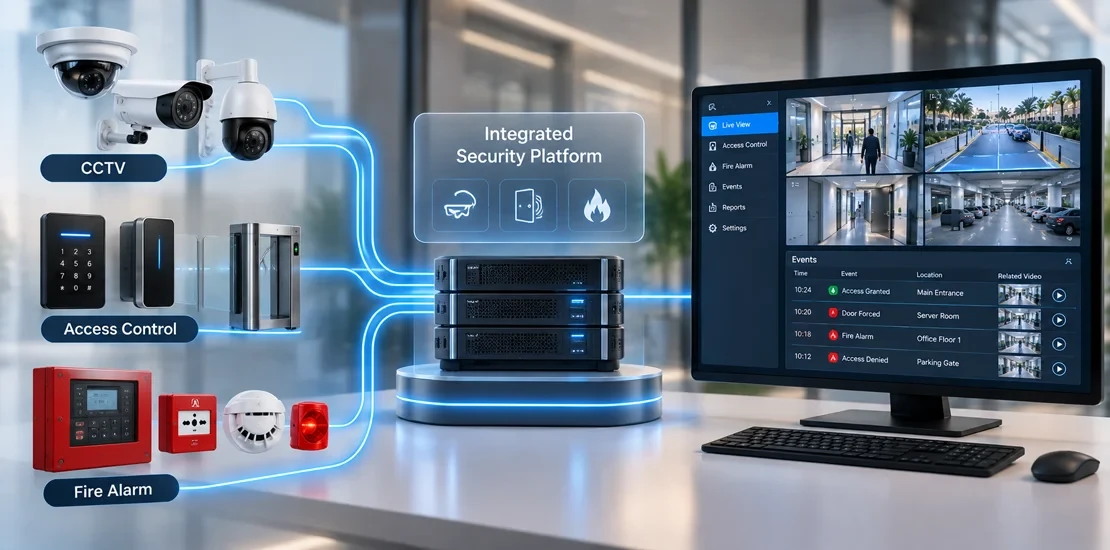
An integrated security system is not simply several systems installed in the same building. It is a setup where video surveillance and the access control system share events, data, and a single operator interface. The platform that connects them is usually a video management system (VMS) with access control integration, or a broader physical security information management platform (PSIM) for larger sites.
The practical test is simple: when a door event occurs, does the operator see the related camera automatically, on the same screen, with the event recorded in one log? If the answer is no, the systems are installed side by side, not integrated.
Separate Systems vs an Integrated Platform
| Area | Separate Systems | Integrated Platform |
| Operator interface | Multiple screens and programs | One interface for video and access events |
| Incident response | Operator searches for the right camera manually | Related camera appears automatically with the event |
| Investigations | Video and access logs reviewed separately | Search video directly by access event, person, or door |
| Reporting | Scattered reports from each system | Unified reports and audit trail |
| Training | Staff trained on several systems | Staff trained on one platform |
| Scalability | Each system expanded separately | New sites and devices added to one platform |
Key Components of an Integrated Security System
Before planning an integration project, it helps to understand the building blocks that every integrated security system relies on:
- IP cameras and video recorders. Cameras capture the video, while network video recorders or recording servers store it for the required retention period and stream it to the platform.
- Access control hardware. Card or biometric readers, door controllers, electric locks, door position sensors, and exit buttons work together to decide who can pass and to report every door event.
- The integration platform. The VMS or PSIM software receives events from both systems, links them together, and presents them to operators on one interface.
- Network infrastructure. Switches, cabling, and, in larger sites, fiber links carry video and event data reliably between devices, servers, and the control room.
- Control room equipment. Video walls, operator workstations, and alarm management tools turn the collected data into fast decisions.
- Power backup. UPS units and backup power for controllers, locks, and servers keep the system running during power interruptions.
A weakness in any one of these layers limits the whole system, which is why integration projects should be designed as a complete solution rather than treated as a software purchase.
How CCTV and Access Control Work Together
Integration changes how daily security events are handled. The most useful scenarios include:
- Event-triggered video. When a door is forced open or held open too long, the platform instantly shows the live and recorded video from the camera covering that door.
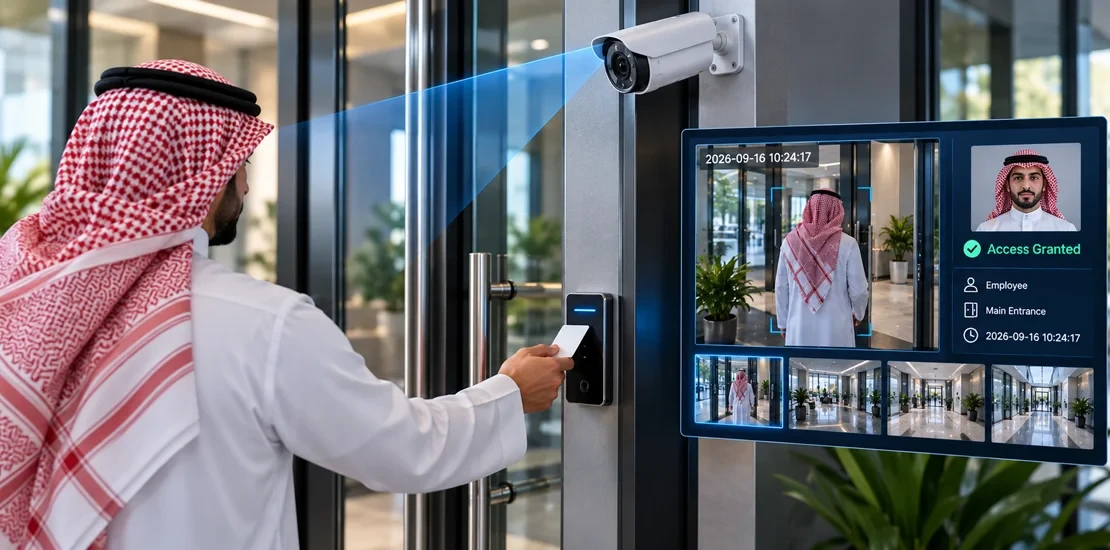
- Visual identity verification. When a card or credential is used at a sensitive entrance, the operator can compare the cardholder’s photo with the live video to detect shared or stolen cards.
- Faster investigations. Instead of scrolling through hours of recordings, investigators select an access event and jump directly to the matching video clip.
- Visitor and contractor management. Temporary credentials are linked to video recordsecurity consultations, so every visitor movement can be traced when needed.
For these scenarios to work, the CCTV system must deliver clear images at every controlled door, with cameras positioned to capture faces at the point of entry rather than general wide views.
A Real-World Scenario: A Forced Door After Hours
To see the difference integration makes, consider a warehouse emergency exit that is forced open at 2:00 a.m.
With separate systems, the access control software records a door alarm on one screen. The operator must identify the door, find the camera that covers it among dozens of feeds, and search the recording manually to see what happened. By the time the right video appears, the intruder may have already left the camera’s view.
With an integrated platform, the same event instantly opens the live view and the recorded clip from the moment the door was forced on the operator’s main screen, marked as a high-priority alarm. The platform displays the response procedure, the operator confirms what is happening within seconds, and the guard team is notified with the exact location. The whole incident, including the video, the door event, and every operator action, is saved in one report ready for management or the authorities.
Designing the Central Control Room
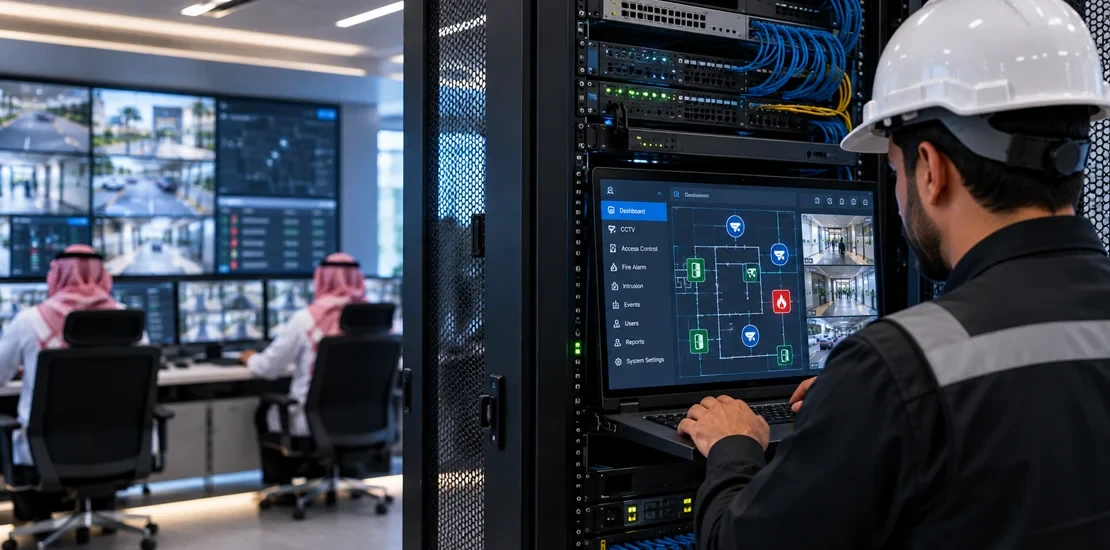
The control room is where integration becomes visible. A well-designed room is built around how operators actually respond to events, not just around how many screens it can hold. Key design points include:
- Video wall and workstations. The video wall gives an overall site view, while each operator workstation handles alarms and investigations in detail.
- Alarm prioritization. Events are ranked by severity so that a forced door at a server room appears before a routine door-held alarm at a staff entrance.
- Standard operating procedures. Every alarm type needs a written response procedure that the platform can display to the operator when the event occurs.
- Servers, recorders, and network switches need UPS backup and, for critical sites, redundant servers so that monitoring does not stop during a failure.
- Operator fatigue directly affects detection, so screen layout, lighting, and shift planning matter as much as the technology.
Connecting the Fire Alarm to the Security Platform
The security platform should also receive signals from the fire alarm panel. When a fire alarm is activated, the platform can release access-controlled doors on escape routes, display cameras covering the affected area, and use access records to support headcounts at assembly points.
This level of interface works best with an addressable fire alarm system, because it reports the exact device location rather than a general zone, allowing the security platform to call up the right cameras and doors automatically. Door release on fire alarm must always follow Civil Defense requirements and be verified during testing.
Where Intrusion Alarms Fit In
Intrusion detection sensors can also feed the same platform, so that a motion or glass-break alarm triggers the relevant camera view. Because this topic has its own design considerations, we cover it separately in our guide on integrating alarm systems with intrusion protection.
Open Platforms vs Closed Systems
One of the most important decisions in an integration project is whether to choose an open platform or a single-vendor closed system. Open platforms support widely used standards such as ONVIF for IP cameras and OSDP for secure communication between card readers and controllers, which lets the facility add devices from different manufacturers over time.
Closed systems can be easier to deploy at first, but they may lock the facility into one vendor for every future expansion. For facilities that plan to grow or already own equipment from several brands, an open platform usually offers better long-term value.
Cybersecurity and Data Protection
Connecting security systems on one network also makes that network a target. An integrated security system should be protected with a separate network segment for security devices, changed default passwords, encrypted communication, regular firmware updates, and role-based user permissions so that each operator only accesses what their job requires.
Facilities should also confirm that video recording, retention, and access to recordings comply with Saudi regulations on security surveillance cameras and with the organization’s own data protection policies.
It is also good practice to review user logins to the platform itself regularly, remove access for staff who change roles or leave immediately, and run a network security test after any major expansion, so the system designed to protect the facility does not become a weak point.
Which Facilities Benefit Most
Integrated security systems in Saudi Arabia deliver the clearest value in facilities with many entrances, many users, or high-value assets, including:
- Shopping malls and mixed-use developments with multiple entrances and service areas.
- Hospitals, where restricted zones such as pharmacies and operating rooms need strict access with video verification.
- Factories, warehouses, and logistics hubs with large perimeters and contractor movement.
- Corporate headquarters and multi-tenant office towers.
- Residential compounds, schools, and universities that manage residents, students, and visitors.
Operational Benefits Beyond Security
The value of integrated security systems in Saudi Arabia goes beyond stopping incidents. Facility managers also gain several operational advantages:
- Lower guard workload. Operators verify many alarms remotely through video, reducing unnecessary patrols to check false door alarms.
- Clear audit trails. Unified reports show who accessed sensitive areas and when, supported by video evidence, which helps with internal audits, insurance claims, and regulatory inspections.
- Better use of space and staff. Access data shows how areas are actually used, supporting decisions about staffing, opening hours, and space planning.
- Consistent standards across branches. Organizations with several sites can apply the same rules, procedures, and reporting everywhere from one central platform.
How to Implement an Integrated System Step by Step
- Assess the site and existing equipment. Start with a security risk assessment and an audit of current cameras, readers, and network infrastructure to decide what can be reused.
- Define operating scenarios. Agree on which events should trigger which actions before choosing any software.
- Design the platform and control room. Select the platform, plan the network, and design the control room layout.
- Integrate in phases. Connect critical areas first, test each scenario, then expand to the rest of the site.
- Test and train. Run realistic scenario tests and train operators on the procedures, not only on the software.
- Maintain and review. Schedule regular maintenance and review event reports to adjust rules and reduce nuisance alarms.
Specialized security consultation at the first step prevents the most expensive mistake: buying software before defining what the facility actually needs it to do.
Common Mistakes to Avoid
- Buying technology before defining scenarios. Without clear response scenarios, the platform ends up used as a simple video viewer.
- Ignoring existing equipment compatibility. Some older cameras or controllers may not integrate, and discovering this late increases cost.
- Alarm overload. Sending every minor event to operators leads to alarm fatigue and missed real incidents.
- Weak network design. Running security devices on the general office network creates both performance and cybersecurity risks.
- No operator training. An advanced platform with untrained operators delivers little more than separate systems.
- Missing documentation at handover. Without updated drawings, device lists, user permissions, and configured rules, every future change or troubleshooting visit starts from zero.
Conclusion
Integrated security systems turn separate cameras and card readers into one coordinated security operation. By unifying CCTV and access control in one control room, and connecting the platform to the fire alarm, facilities gain faster response, easier investigations, clearer reporting, and better use of the equipment they already own. The key to success is planning the scenarios and the control room first, then choosing the technology that fits them.
Planning to unify your security systems? The CCCO team can assess your current CCTV and access control equipment, design the right integration platform and control room, and implement it in phases with minimal disruption to your operations. Contact us to request a site assessment.
Frequently Asked Questions
What is an integrated security system?
It is a setup where CCTV and access control share events and data on one platform, managed through a single operator interface, instead of working as separate systems.
Can we integrate our existing cameras and card readers?
Often yes, especially if the devices support open standards such as ONVIF or OSDP. A site audit determines which devices can be reused and which need replacement.
What is the difference between a VMS and a PSIM?
A VMS manages video and can integrate access control events, while a PSIM is a broader layer that connects many security and building systems and guides operators through response procedures. Smaller and medium sites usually need a VMS with integration, while large or multi-site operations may need a PSIM.
Does integration require replacing all existing systems?
Not necessarily. Many projects keep compatible equipment and add an integration platform, replacing only devices that cannot connect.
Can the integrated platform be monitored remotely?
Yes, authorized users can access the platform remotely through secure connections, which is useful for multi-site organizations, provided cybersecurity controls are in place.
How does integration help during a fire emergency?
When linked to the fire alarm panel, the platform can release escape doors, display cameras in the affected area, and use access records to support headcounts at assembly points.
How long does an integration project take?
It depends on the facility size, the number of devices, and the condition of existing equipment. Phased implementation allows critical areas to go live first while the rest of the site is completed.
Can biometric readers be used in an integrated security system?
Yes. Most modern platforms support fingerprint and facial recognition readers alongside cards, provided the readers are compatible with the chosen access control system and personal data is handled according to applicable privacy requirements.