 Get a Quote

Fire Sprinkler System: Types, Components and Installation Requirements
Fire Sprinkler System: Types, Components and Installation Requirements
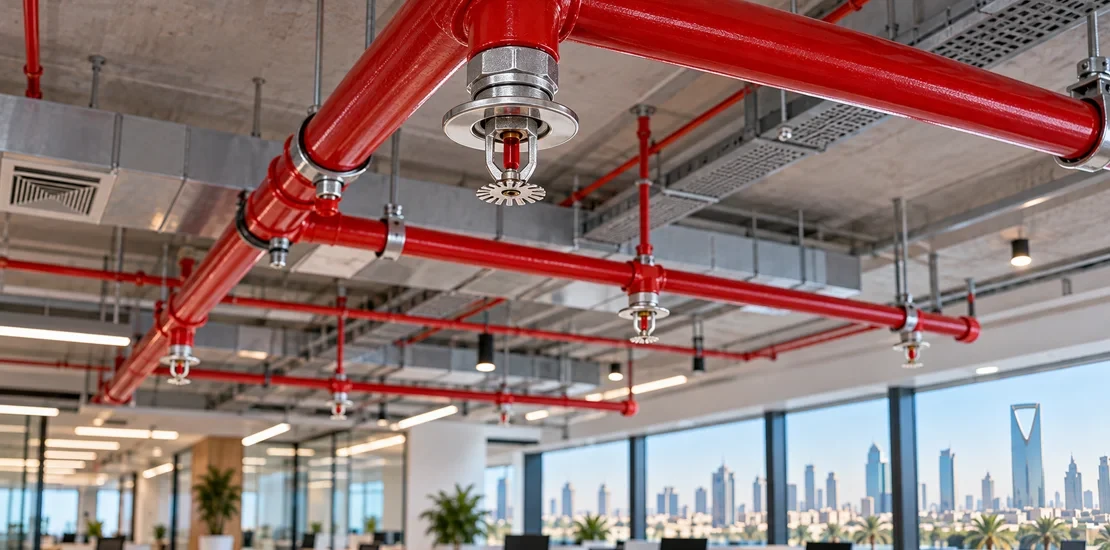
Most fires start small. What decides whether a fire stays in one corner of a room or spreads through an entire building is how quickly water reaches it. A fire sprinkler system is designed to do exactly that: detect the heat of a growing fire and discharge water automatically, right above the source, often before the fire brigade arrives.
In Saudi Arabia, a fire sprinkler system is required in many commercial, industrial, and public buildings, and it is one of the most reliable ways to protect lives and property. This guide explains how a fire sprinkler system works, the main system types and components, how sprinkler heads are selected, and the installation requirements facility owners should understand before starting a project.
What Is a Fire Sprinkler System?
A fire sprinkler system is a network of pipes filled with water, or ready to receive water, connected to sprinkler heads installed across the ceiling of a building. Each head contains a heat-sensitive element that keeps it closed under normal conditions. When the temperature at the head reaches its rated level, the element breaks or melts, the head opens, and water is discharged onto the fire below.
A fire sprinkler system is one of several firefighting systems used in commercial buildings, and it is usually the backbone of fire protection in offices, malls, hotels, hospitals, warehouses, and factories because it works automatically, around the clock, without relying on people to act.
How a Fire Sprinkler System Works
The operating sequence of a typical fire sprinkler system is simple and reliable:
- Heat builds up. Hot gases from the fire rise and spread across the ceiling.
- The nearest head activates. When the heat-sensitive glass bulb or fusible link reaches its rated temperature, only that sprinkler head opens.
- Water flows. Pressurized water discharges through the open head and is spread by the deflector over the area below.
- The alarm sounds. Water movement in the pipes triggers a flow switch or alarm valve, which signals the fire alarm panel and sounds the alarm.
- The fire is controlled. The water cools the fire and the surrounding area, controlling or extinguishing it until firefighters arrive.
A common misunderstanding, often shaped by films, is that all heads in a fire sprinkler system open at once. In reality, standard systems only open the heads directly exposed to the fire’s heat. In most fires, one or two heads are enough to control the fire, which also limits water damage.
Types of Fire Sprinkler System
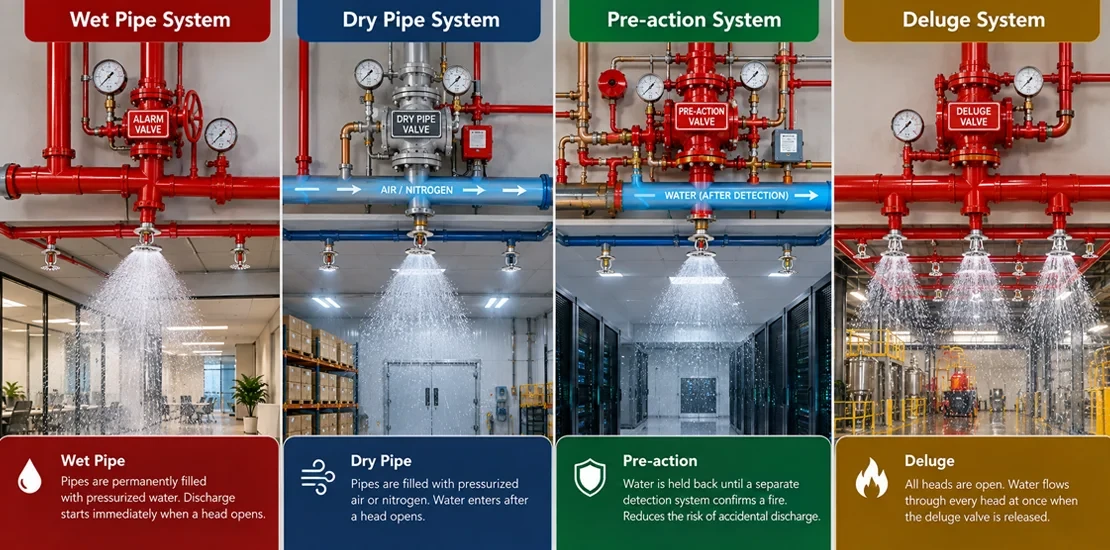
There are four main types of fire sprinkler system, each suited to different conditions:
- Wet pipe system. The pipes are permanently filled with pressurized water, so discharge starts immediately when a head opens. It is the simplest, most reliable, and most common type, suitable for most offices, hotels, malls, and residential buildings.
- Dry pipe system. The pipes are filled with pressurized air or nitrogen, and water is held back by a dry pipe valve. When a head opens, the air escapes and water enters the pipes. It is used where pipes may freeze, such as cold stores and unheated areas.
- Pre-action system. Water is held back until a separate detection system confirms a fire. This reduces the risk of accidental discharge, making it suitable for data centers, archives, museums, and other water-sensitive areas.
- Deluge system. All heads are open, and water flows through every head at once when the deluge valve is released by a detection system. It is used for high-hazard areas where fire can spread very fast, such as fuel storage, transformers, and some industrial processes.
| Type | Pipes in Normal Condition | Best Use |
| Wet pipe | Filled with water | Offices, malls, hotels, hospitals, residential buildings |
| Dry pipe | Filled with air or nitrogen | Cold stores and areas exposed to freezing |
| Pre-action | Dry until detection confirms fire | Data centers, archives, museums |
| Deluge | Dry with open heads | Fuel storage, transformers, high-hazard industrial areas |
In most commercial buildings in Saudi Arabia, a wet pipe fire sprinkler system is the standard choice, while the other types are used for specific rooms or risks within the same facility.
Main Components of a Fire Sprinkler System
- Water supply. A dedicated fire water tank or a reliable connection that can provide the required flow and pressure for the design duration.
- Fire pump. Boosts the water pressure to the level required by the hydraulic design, usually supported by a jockey pump that maintains system pressure.
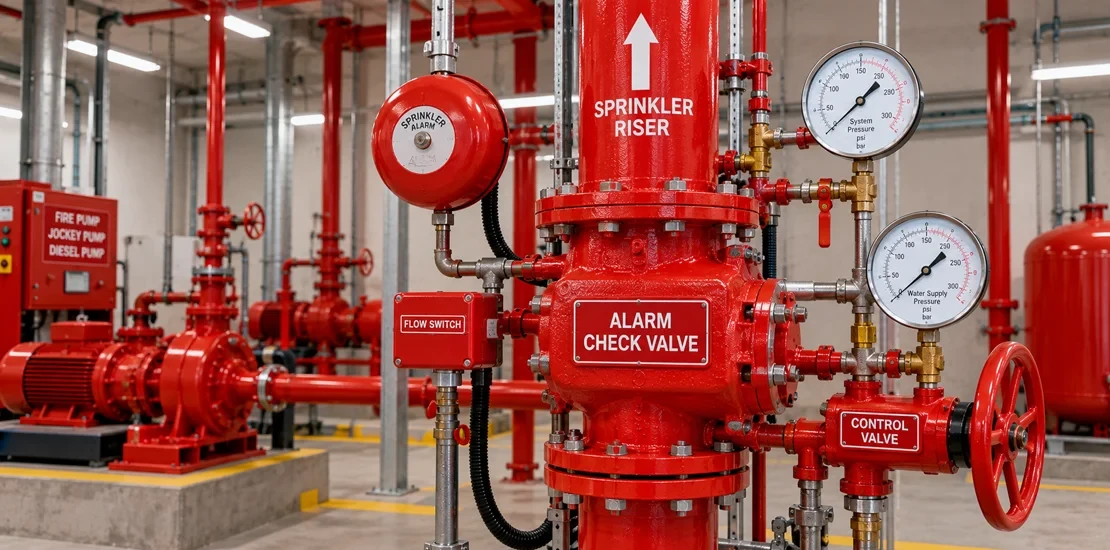
- Riser and alarm valve. The main vertical pipe feeding each zone, with an alarm check valve or zone control assembly that signals when water flows.
- Control valves. Valves that isolate the system or zones for maintenance, supervised by tamper switches so a closed valve is reported to the fire alarm panel.
- Flow switches. Devices that detect water movement in a zone and send an alarm signal.
- Pipe network. Mains, branch lines, and fittings that carry water to every head, sized by hydraulic calculation.
- Sprinkler heads. The devices that open and spray water over the protected area.
- Test and drain valves. Used to test water flow and alarms and to drain the system for maintenance.
- Fire department connection. An external inlet that allows the fire brigade to pump additional water into the system.
Types of Sprinkler Heads
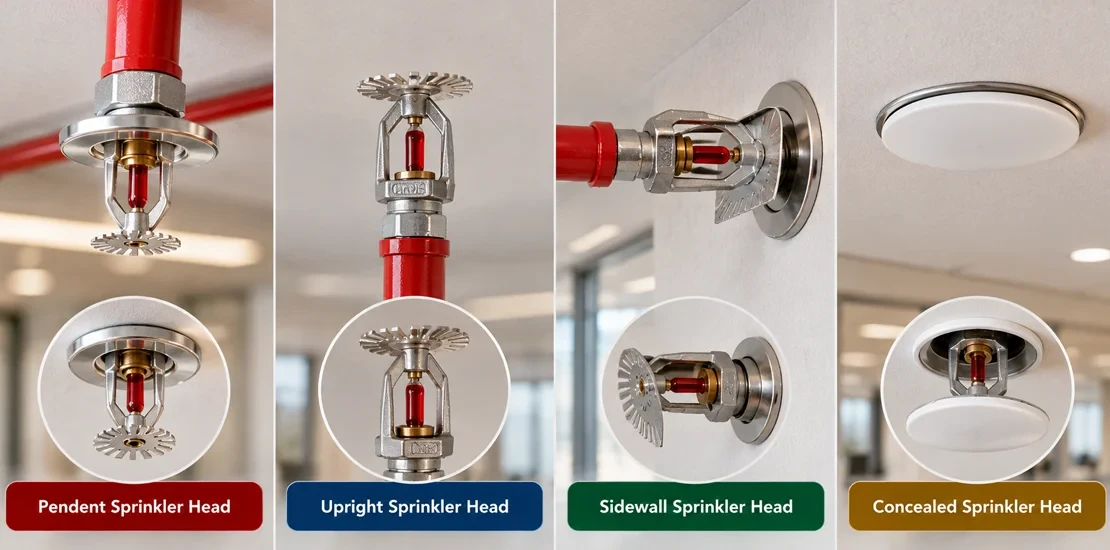
The choice of sprinkler head affects both performance and appearance. The most common head types are:
- Pendent heads hang down from the ceiling and are the most widely used in offices and commercial spaces.
- Upright heads point upward from exposed pipes and are common in warehouses, plant rooms, and car parks.
- Sidewall heads are mounted on walls and spray water outward, useful in corridors and rooms where ceiling piping is difficult.
- Concealed heads are hidden behind a flat cover plate that drops away in a fire, preferred in hotels and high-end interiors.
- Storage heads (such as ESFR) are designed for high-piled storage in warehouses, delivering large volumes of water quickly to suppress fires in racks.
Heads also differ in temperature rating, usually indicated by the color of the glass bulb. For example, red bulbs commonly operate at about 68°C, while higher-rated bulbs are used near heat sources such as kitchens, skylights, or equipment rooms. Selecting the correct temperature rating prevents both delayed operation and accidental activation.
Hazard Classification and System Design
A fire sprinkler system is not designed by simply placing heads at equal distances. Designers first classify the hazard of each area according to standards such as NFPA 13, based on the amount and type of combustible materials:
- Light hazard. Offices, hotel rooms, classrooms, and hospitals, where fuel loads are relatively low.
- Ordinary hazard. Retail shops, restaurants, car parks, and light manufacturing, with moderate fuel loads.
- Extra hazard. Areas with flammable liquids or processes that can produce very fast-growing fires.
- Warehouses, where the commodity type and storage height strongly affect the design.
The hazard class determines the water density, the area of operation, the head spacing, and the water supply duration. A hydraulic calculation then confirms that the pipes, pump, and water tank can deliver the required flow and pressure to the most remote heads.
Fire Sprinkler System Requirements in Saudi Arabia
In the Kingdom, a fire sprinkler system must comply with the fire protection requirements of the Saudi Building Code (SBC 801) and the approvals of the General Directorate of Civil Defense, which draw on international standards such as NFPA 13 for design and installation and NFPA 25 for inspection and maintenance. Sprinklers are required in many occupancies depending on building type, height, area, and use, including malls, high-rise buildings, hospitals, hotels, and large warehouses.
Key requirements typically include approved design drawings and hydraulic calculations, listed and approved components, a dedicated water supply with adequate capacity, supervised control valves, and connection to the building’s fire alarm system. For an overview of how compliance is reviewed, see our guide on Saudi Civil Defense standards. Facility owners should always confirm the exact requirements for their building type with the approved designer before installation begins.
Installation Requirements and Best Practices
Correct installation is just as important as correct design. The main installation requirements for a fire sprinkler system include:
- Approved design first. Installation should only start after the drawings and hydraulic calculations are reviewed and approved.
- Correct spacing and positioning. Heads must follow the approved spacing and distance from walls and ceilings, and must not be blocked by beams, ducts, or lighting.
- Clearance below heads. Storage and furniture must be kept below the required clearance so water can spread properly.
- Proper pipe support. Pipes must be supported by approved hangers at the correct intervals and never used to carry other services.
- Approved materials. Pipes, fittings, valves, and heads must be listed for fire protection use and suitable for the pressure and environment.
- Pressure testing and flushing. The completed system must be flushed and hydrostatically tested according to the applicable standard before being placed in service.
- Acceptance testing and documentation. Flow tests, alarm tests, and valve checks should be witnessed, with as-built drawings and test certificates handed over to the owner.
Climate and Water Quality Considerations in Saudi Arabia
Local conditions affect how a fire sprinkler system performs over time. High ambient temperatures in roof spaces, plant rooms, and unshaded areas must be considered when selecting head temperature ratings, so heads do not operate accidentally in normal summer heat. Water quality also matters: hard or poorly treated water can accelerate internal corrosion and scale build-up in steel pipes, which may reduce flow and block small heads over the years. Using suitable pipe materials, keeping fire water tanks clean and covered, and flushing and inspecting the network periodically help keep the fire sprinkler system reliable in the Kingdom’s climate.
Connecting the Fire Sprinkler System to the Fire Alarm
A fire sprinkler system should never operate in isolation. Flow switches and valve tamper switches must be connected to the fire alarm panel, so that water flow triggers an evacuation alarm and a closed valve is reported as a fault. With an addressable fire alarm system, each flow switch and tamper switch can be identified by its exact location, allowing staff to see immediately which zone is discharging or which valve has been closed.
Where a Fire Sprinkler System Is Not the Right Choice
Water is highly effective against most fires, but some areas need a different approach. Server rooms, telecom rooms, electrical switchgear, archives, and museums may suffer serious damage from water. In these spaces, a clean agent solution such as an FM200 fire suppression system, or a pre-action fire sprinkler system, is often more suitable. The right solution depends on the risk assessment and the approval requirements for each area.
Maintaining a Fire Sprinkler System
A fire sprinkler system can remain in service for decades, but only if it is maintained properly. Regular care includes keeping control valves open and supervised, checking gauges and alarm devices, inspecting heads for paint, corrosion, or damage, testing water flow and alarms, and running fire pumps as required. Any head that has operated or been damaged must be replaced with a head of the same type and rating.
Using a structured fire system inspection checklist helps facility teams cover every item consistently, while a specialized maintenance and support provider handles functional tests and repairs in line with NFPA 25 and Civil Defense requirements.
Common Myths About Fire Sprinkler Systems
- “All sprinklers go off together.” In wet and dry pipe systems, only the heads exposed to the fire’s heat open.
- “Smoke or burnt toast sets them off.” Standard sprinkler heads respond to heat, not smoke.
- “Sprinklers cause more damage than the fire.” A controlled discharge from one or two heads usually causes far less damage than an uncontrolled fire and firefighting hoses.
- “Sprinklers leak often.” Properly installed and maintained systems are very reliable, and accidental discharge is rare.
Common Mistakes to Avoid
- Changing the layout without reviewing the design. New partitions, mezzanines, or higher storage can leave areas unprotected.
- Painting sprinkler heads. Paint can delay or prevent a head from opening and requires head replacement.
- Leaving valves closed after maintenance. A closed control valve can disable an entire zone without anyone noticing.
- Using the wrong replacement heads. Replacement heads must match the original type, response, and temperature rating.
- Ignoring the water supply. A perfect pipe network is useless if the tank or pump cannot deliver the required flow.
Conclusion
A fire sprinkler system is one of the most effective ways to protect people and property in commercial facilities. By choosing the right system type, selecting suitable sprinkler heads, designing according to the hazard class, and installing and maintaining the system in line with Saudi Civil Defense requirements, facility owners in Saudi Arabia can make sure their fire sprinkler system will respond quickly and reliably when a fire starts.
Planning a fire sprinkler system for your facility? The CCCO team can assess your building, design and install a compliant fire sprinkler system, connect it to your fire alarm, and provide ongoing maintenance to keep it ready at all times. Contact us to request a site assessment.
Frequently Asked Questions
What is a fire sprinkler system?
It is an automatic fire protection system that uses a network of pipes and heat-activated sprinkler heads to discharge water directly over a fire.
Do all heads in a fire sprinkler system activate at the same time?
No. In wet and dry pipe systems, only the heads exposed to enough heat open. All heads discharge together only in deluge systems.
Which fire sprinkler system type is most common?
The wet pipe system is the most common because it is simple, reliable, and suitable for most commercial buildings.
Is a fire sprinkler system required in Saudi Arabia?
Sprinklers are required in many building types depending on use, height, and area, according to the Saudi Building Code and Civil Defense requirements.
Can a fire sprinkler system be installed in an existing building?
Yes. Retrofitting is possible after a site survey, hydraulic design, and planning of pipe routes to minimize disruption to operations.
Is a fire sprinkler system suitable for server rooms?
Standard wet systems are usually not preferred in server rooms. Clean agent systems or pre-action sprinklers are more common in water-sensitive areas.
How long does a fire sprinkler system last?
With proper inspection and maintenance, a fire sprinkler system can remain effective for decades, although some components such as heads may need testing or replacement over time