 Get a Quote

Perimeter Security Systems: How to Protect Industrial and Commercial Sites
Perimeter Security Systems: How to Protect Industrial and Commercial Sites
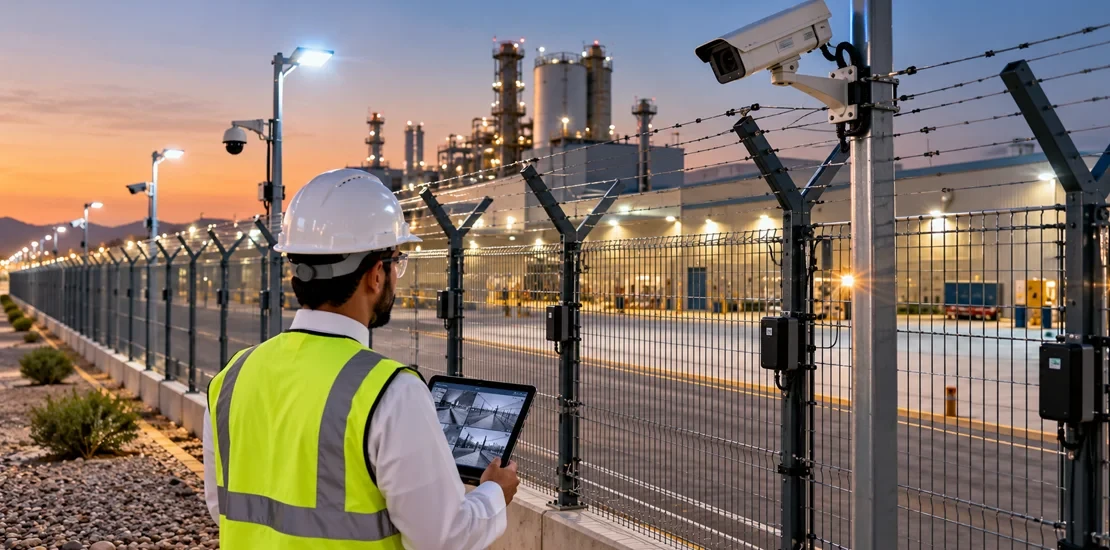
For factories, warehouses, logistics yards, utilities, and large commercial compounds, the first line of defense is not the building door but the site boundary. An intruder who reaches the buildings unnoticed has already won valuable time. Perimeter security systems are designed to stop that from happening by deterring, detecting, and delaying anyone who tries to cross the boundary, and by giving the security team the information they need to respond quickly.
This guide explains how perimeter security systems work, the main physical and electronic layers, the detection technologies available, how to secure gates and entry points, how local conditions in Saudi Arabia affect design, and the practical steps to plan an effective perimeter for an industrial or commercial site.
What Are Perimeter Security Systems?
Perimeter security systems are a combination of physical barriers, detection technologies, video surveillance, lighting, and procedures that protect the outer boundary of a site. Their purpose is to control who crosses the boundary, to detect unauthorized attempts as early as possible, and to provide enough delay for guards or police to respond.
A fence on its own is not a security system. It becomes part of one when it is combined with sensors that detect climbing or cutting, cameras that confirm what is happening, lighting that supports observation, and a control room that knows exactly where the alarm came from and what to do next.
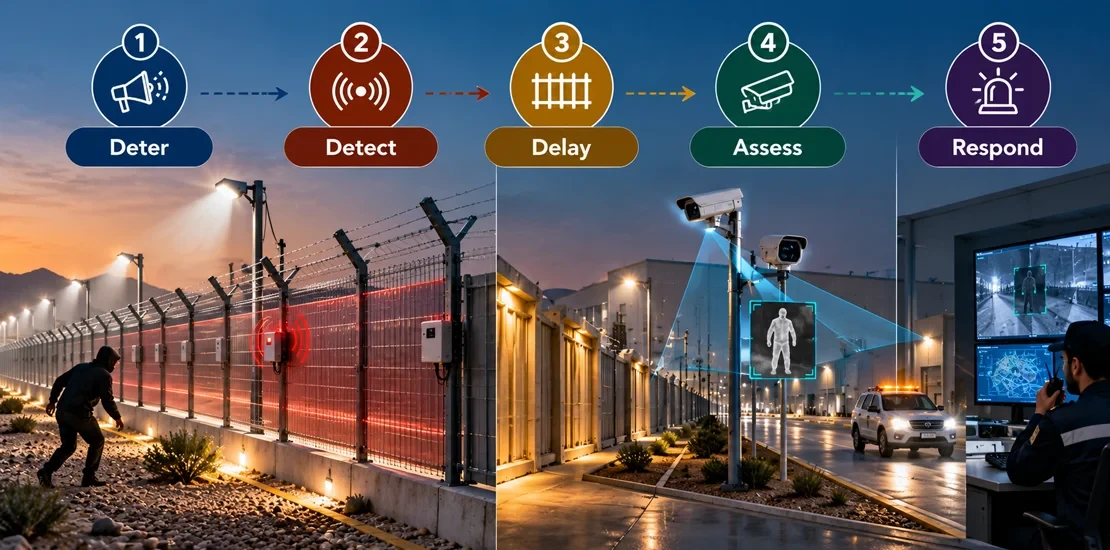
The Five Layers: Deter, Detect, Delay, Assess, Respond
Effective perimeter security systems are built around five functions that work together:
- Visible fences, lighting, signage, and cameras discourage many potential intruders before they try anything.
- Sensors identify an intrusion attempt at the boundary, ideally at the moment someone climbs, cuts, or crosses.
- Physical barriers slow the intruder down long enough for the response team to act.
- Cameras and video analytics allow operators to verify the alarm quickly and see who or what caused it.
- Guards, patrols, or police are dispatched to the exact zone with clear information.
A weakness in any layer reduces the value of the others. For example, excellent detection is of little use if the fence offers no delay, or if no one is available to respond.
Physical Barriers: The Foundation of the Perimeter
- Fences and walls. Anti-climb mesh fences, palisade fences, and concrete walls define the boundary and provide delay. The right choice depends on the risk level and visibility needs.
- Barbed wire, razor wire, or anti-climb toppings increase the time needed to scale the fence, where permitted.
- Vehicle barriers. Bollards, crash-rated barriers, and road blockers protect against vehicles being used to break through gates or fences at high-risk sites.
- Gates and turnstiles. Controlled openings for people and vehicles, which are often the weakest points if not managed properly.
- Clear zones. Keeping a strip on both sides of the fence free of vegetation, stored materials, and structures removes hiding places and climbing aids.
Perimeter Intrusion Detection Technologies
Perimeter intrusion detection is the electronic heart of perimeter security systems. Different technologies suit different fences, terrain, and risk levels, and they work alongside intrusion alarm systems inside the site:
| Technology | How It Detects | Best Use |
| Fence-mounted sensors | Detect vibration or movement when the fence is climbed or cut | Existing mesh fences on long boundaries |
| Fiber optic fence sensors | A fiber cable on the fence detects disturbance along its length | Long perimeters needing no power in the field |
| Buried sensors | Detect pressure or ground disturbance below the surface | Covert detection and open areas without fences |
| Microwave barriers | Create an invisible detection zone between transmitter and receiver | Gates, open gaps, and flat clear zones |
| Active infrared beams | Detect when invisible beams between posts are interrupted | Short straight sections, walls, and rooftops |
| Ground radar | Tracks movement across wide open areas | Large yards, utilities, and open land |
| Video analytics and thermal cameras | Analyze images to detect people or vehicles crossing virtual lines | Combined detection and verification along the boundary |
Many sites combine two technologies, such as fence sensors plus video analytics, so that each alarm is detected by one layer and verified by another. This approach improves detection while reducing nuisance alarms.
Video Surveillance and Analytics at the Perimeter
Cameras play two roles in perimeter security systems: they detect intrusions through analytics, and they allow operators to verify alarms. Fixed cameras should cover each detection zone along the fence, while PTZ cameras can follow an intruder once an alarm is raised. Thermal cameras detect body heat at night and in low visibility, and video analytics can ignore small animals or moving vegetation while flagging people and vehicles.
Camera placement is critical. Each zone should be covered without blind spots, with overlapping views at corners and gates. Our guide on CCTV camera placement for warehouses and factories explains these principles in more detail, and professional CCTV systems design ensures the cameras, analytics, and recording match the detection zones.
Perimeter Lighting
Lighting supports both deterrence and assessment. Good perimeter lighting allows guards and color cameras to see clearly, removes dark areas where intruders can hide, and avoids glare that blinds cameras or guards. Many sites use a combination of continuous lighting along the fence and lights that switch on when an alarm is triggered in a specific zone. Infrared illuminators can support cameras at night without lighting up the whole area.
Securing Gates and Entry Points
Gates are where authorized traffic crosses the perimeter, which makes them the most frequently attacked and misused points. Common measures include:
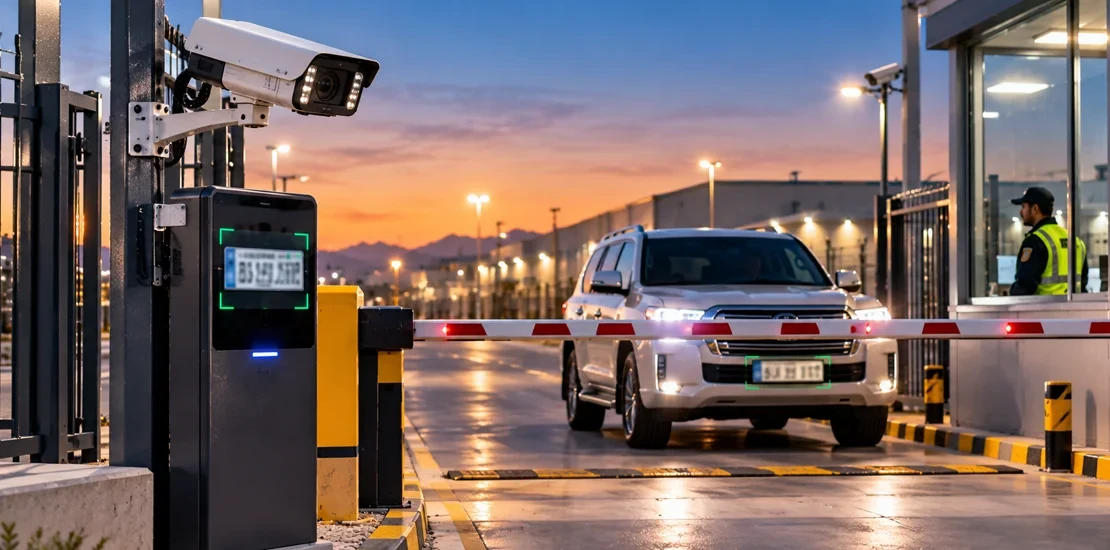
- Vehicle access control. Barriers combined with license plate recognition (ANPR), RFID tags, or guard verification.
- Pedestrian access control. Full-height turnstiles or gates linked to an access control system using cards or biometrics.
- Inspection areas. Space for checking vehicles and deliveries before they enter sensitive parts of the site.
- Anti-tailgating measures. Interlocked gates, traffic lights, and cameras that prevent one vehicle or person from following another inside.
- Gate monitoring. Sensors that report gates left open or forced, with cameras that cover every lane.
Zoning and Alarm Management
Perimeter security systems divide the boundary into detection zones, usually between 50 and 200 meters long depending on terrain and technology. Smaller zones give more accurate locations, allowing operators to call up the right camera instantly and send the response team to the exact spot. Each alarm should be prioritized, verified by video, and logged with the operator’s actions, so the site builds a clear history of events and nuisance alarms that can be reduced over time.
Choosing Perimeter Security Systems by Site Type
The right design depends on what the site protects and how it operates:
- Factories and industrial plants. Long fences with fence-mounted or fiber optic sensors, thermal cameras, strong vehicle gates, and controlled contractor access.
- Warehouses and logistics yards. Detection along the fence and at loading areas, ANPR at truck gates, and cameras covering yards where goods are stored outside.
- Utilities and energy sites. Remote, unmanned boundaries that need layered detection, reliable communication, and fast remote verification.
- Commercial compounds and campuses. A balance between security and a welcoming appearance, often using architectural fences, discreet sensors, and well-designed lighting.
- Construction sites. Temporary fences with wireless sensors and cameras that can be moved as the project progresses.
Matching perimeter security systems to the site type avoids paying for high-security measures where they are not needed, while making sure critical boundaries receive the protection they require.
Perimeter Security Systems in Saudi Arabia’s Environment
Local conditions have a strong effect on how perimeter security systems perform in the Kingdom:
- Sand and dust storms can trigger microwave and infrared detectors, reduce camera visibility, and bury or shift ground-based sensors. Detector selection and settings must account for these conditions.
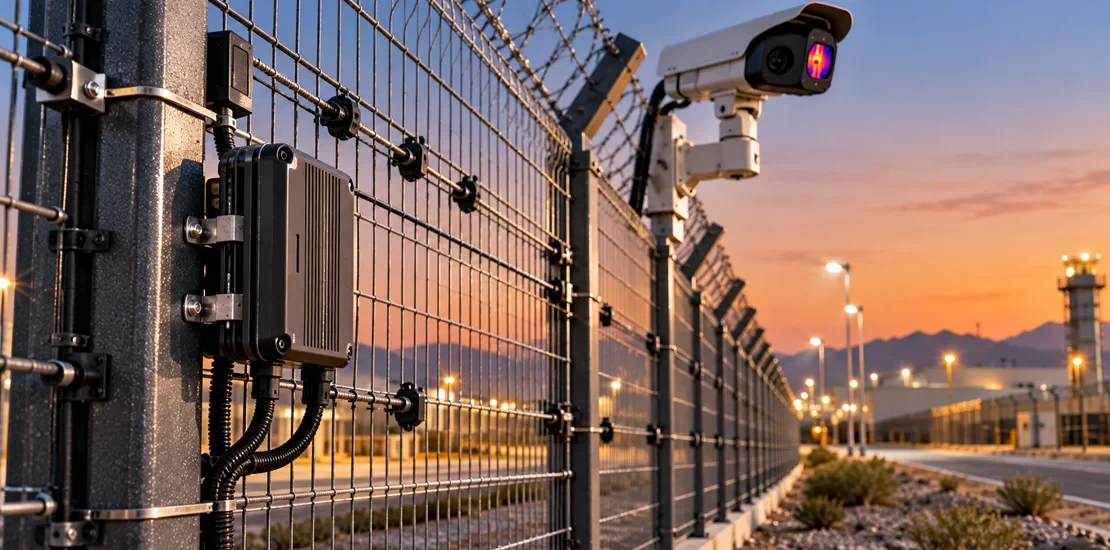
- High temperatures affect electronics in field cabinets, so enclosures need sun shields, ventilation, and components rated for desert heat.
- Thermal camera contrast can drop on very hot days when the ground temperature approaches body temperature, so thermal imaging is often combined with other detection methods.
- Long distances and remote sites require reliable power, fiber or wireless communication, and equipment that needs minimal maintenance.
- Regulatory requirements may apply, such as the rules governing security surveillance cameras and, for certain industrial facilities, the requirements of the High Commission for Industrial Security.
Connecting Perimeter Security Systems to the Control Room
Perimeter alarms are only useful if they reach the right people with the right information. Connecting the perimeter detection, cameras, lighting, and gates to a central platform allows an alarm in one zone to automatically display the relevant cameras, switch on zone lighting, and show the response procedure to the operator. This is where perimeter security systems become part of wider integrated security systems that also manage access control and building alarms from one control room.
How to Design Perimeter Security Systems Step by Step
- Assess the risks. A security risk assessment identifies the threats, the assets that need protection, and the required level of security.
- Survey the boundary. Record the fence type and condition, terrain, vegetation, drainage, gates, and nearby roads or buildings.
- Define the layers. Decide what combination of barriers, detection, cameras, and lighting is needed for each section of the perimeter.
- Plan zones and infrastructure. Divide the perimeter into detection zones and plan power, cabling, and communication to the control room.
- Integrate and test. Connect all systems to the control room, test each zone with realistic intrusion attempts, and fine-tune settings to reduce nuisance alarms.
- Train and maintain. Train operators and guards on response procedures, and schedule regular maintenance and testing.
Independent security consultation at the design stage helps match the solution to the actual threat level and avoids over-investing in one layer while leaving gaps in another.
Maintaining Perimeter Security Systems
Outdoor equipment faces harsh conditions, so regular maintenance is essential. Fences should be inspected for damage, gaps, and corrosion. Sensors need periodic walk tests and recalibration, especially after storms or fence repairs. Camera lenses and housings must be cleaned of dust, vegetation in clear zones should be cut back, and lighting, power supplies, and backup batteries should be checked. Tracking nuisance alarms by zone helps identify sensors that need adjustment or relocation.
Common Mistakes to Avoid
- Relying on the fence alone. Without detection and verification, a fence only delays intruders who may never be noticed.
- Choosing technology before assessing the site. A detector that works well in one environment may generate constant false alarms in another.
- Leaving gates as weak points. Strong fences are wasted if gates are left open, poorly monitored, or easy to tailgate.
- Ignoring nuisance alarms. Operators who receive too many false alarms start ignoring real ones.
- No clear response plan. Detection without a defined response simply records the intrusion instead of stopping it.
Conclusion
Well-designed perimeter security systems stop most threats at the boundary, long before they reach buildings, people, or critical assets. By combining strong physical barriers, the right detection technologies, video verification, effective lighting, controlled gates, and a connected control room, industrial and commercial sites in Saudi Arabia can detect intrusions early and respond with confidence. Regular maintenance and alarm review keep perimeter security systems reliable year after year.
Planning to secure your site perimeter? The CCCO team can assess your boundary, design perimeter security systems that suit your site and risk level, and install and integrate the detection, cameras, lighting, and gate controls you need. Contact us to request a site assessment.
Frequently Asked Questions
What are perimeter security systems?
They are a combination of physical barriers, intrusion detection, cameras, lighting, and procedures that protect the outer boundary of a site and detect unauthorized crossings.
Which perimeter detection technology is best?
There is no single best option. The right technology depends on the fence type, terrain, environment, and risk level, and many sites combine two technologies for detection and verification.
How do perimeter security systems reduce false alarms?
By choosing detectors suited to the site, combining detection with video verification, using analytics that ignore animals and vegetation, and maintaining clear zones along the fence.
Can perimeter security systems be added to an existing fence?
Yes. Fence-mounted or fiber optic sensors can often be installed on existing fences after a survey confirms the fence is in suitable condition.
Do perimeter security systems work in sandstorms?
Some detectors are more affected by sand and dust than others, so technology selection, settings, and video verification should be designed with local weather conditions in mind.
Should perimeter security systems connect to the control room?
Yes. Central monitoring allows each alarm to be verified on camera and responded to quickly, with full records of every event.
How often should perimeter security systems be maintained?
They need regular inspection and testing, with extra checks after storms, fence repairs, or changes on site, according to the facility’s maintenance plan.