 Get a Quote

Kitchen Fire Suppression System: Protecting Restaurant and Commercial Kitchens
Kitchen Fire Suppression System: Protecting Restaurant and Commercial Kitchens
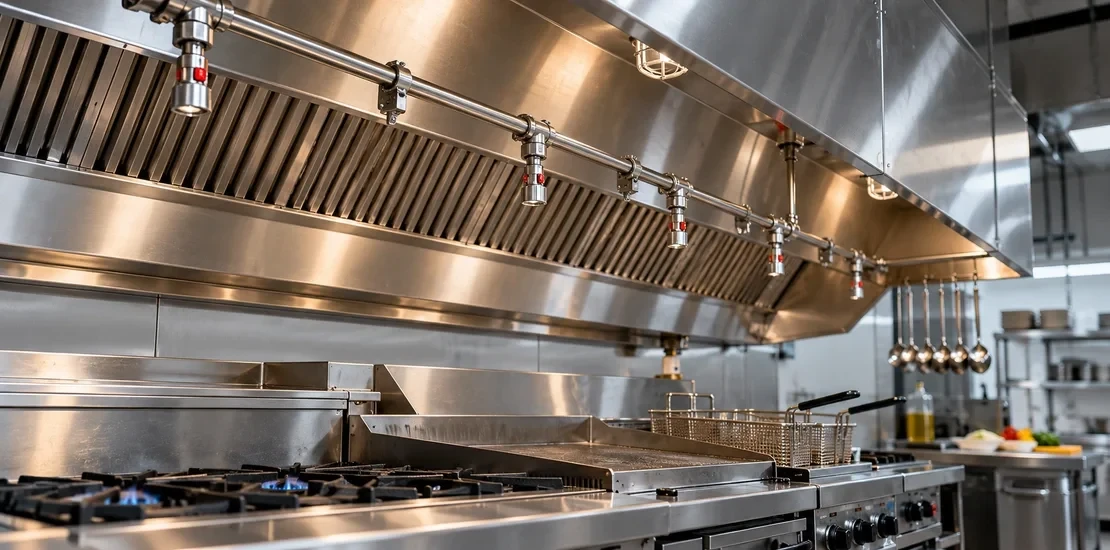
A commercial kitchen combines everything a fire needs in one small space: open flames, extremely hot surfaces, large quantities of cooking oil, and grease-laden exhaust ducts running through the building. A pan of oil that overheats for a few seconds can ignite, and within moments the fire can be drawn into the hood and the duct, where it is hard to reach and quick to spread. For restaurants, cafés, hotels, hospitals, and food courts, a kitchen fire suppression system is the line of protection that acts in those critical first seconds.
This guide explains what a kitchen fire suppression system is, how it works, its main components, why water and ordinary extinguishers are not enough, the requirements for kitchens in Saudi Arabia, and how to keep the system ready. If you own, manage, or are about to open a food business, this is the information that protects your staff, your customers, and your investment.
Why Every Commercial Kitchen Needs Dedicated Protection
Kitchen fires are among the most common fires in commercial buildings. They usually start on cooking appliances such as deep fryers, griddles, woks, and charbroilers, and they often involve cooking oils heated to very high temperatures. Unlike paper or wood fires, these fires cannot be safely handled with water, and they can re-ignite even after the visible flames disappear.
A fire that reaches the exhaust duct can travel through the building and into other floors or tenants. The consequences go far beyond the kitchen itself: injuries, closure of the restaurant, damage claims from neighbors or the mall operator, and problems with insurance and with renewing your civil defense safety license. A properly designed kitchen fire suppression system addresses this risk at its source.
What Is a Kitchen Fire Suppression System?
A kitchen fire suppression system is a pre-engineered fire protection system installed in the exhaust hood above cooking appliances. It detects a fire automatically, discharges a special extinguishing agent directly onto the appliances, into the hood plenum, and into the exhaust duct, and at the same time shuts off the fuel supply to the cooking equipment.
Most modern systems use a wet chemical agent designed for cooking oil and fat fires. They are part of the wider family of fire suppression systems, but they are engineered specifically for the conditions of commercial cooking, with nozzles, detection, and shut-off devices designed for hoods and ducts.
How a Kitchen Fire Suppression System Works
- Heat detectors, usually fusible links or linear heat detection installed in the hood and duct, respond when temperatures rise to a fire level.
- Automatic release. The detection system triggers the release mechanism, which pressurizes the agent cylinder.
- The wet chemical agent flows through pipes to nozzles positioned over each appliance, in the plenum, and at the duct entrance.
- Fuel shut-off. The gas supply valve closes automatically, and electrical cooking equipment is switched off, removing the heat source.
- Fire control. The agent cools the oil and reacts with it to form a soapy foam layer that smothers the fire and prevents re-ignition.
- The system signals the building fire alarm and alerts staff so the area can be evacuated and the fire brigade called if needed.
The system can also be operated manually using a pull station located on the escape route from the kitchen, so staff can activate it immediately if they see a fire before the detectors respond.
Why Water Cannot Replace a Kitchen Fire Suppression System
Before looking at what a kitchen fire suppression system does, it helps to understand why water fails. Throwing water on burning cooking oil is one of the most dangerous mistakes in a kitchen. Water sinks below the hot oil, turns instantly into steam, and throws burning oil into the air, creating a fireball that can injure staff and spread the fire. Standard powder extinguishers may knock down flames briefly, but they do not cool the oil enough, and the fire can re-ignite. Powder also contaminates food areas and equipment.
Wet chemical agents work differently. They cool the oil below its ignition temperature and create a layer of foam on the surface through a reaction known as saponification. This is why a kitchen fire suppression system and Class K (or Class F) extinguishers are the recognized solution for cooking oil fires.
Main Components of a Kitchen Fire Suppression System
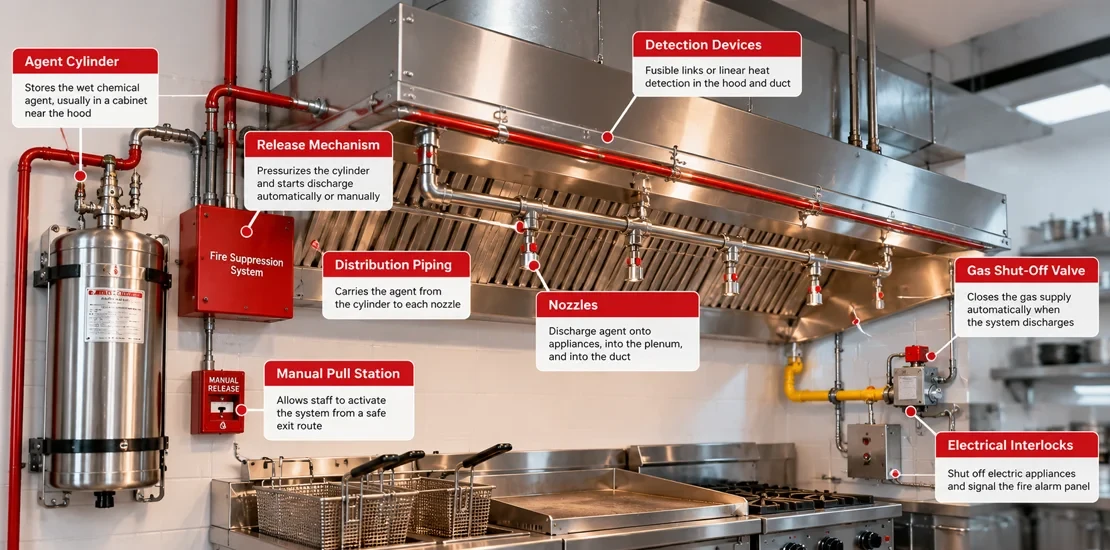
| Component | Function |
| Agent cylinder | Stores the wet chemical agent, usually in a cabinet near the hood |
| Release mechanism | Pressurizes the cylinder and starts discharge automatically or manually |
| Detection devices | Fusible links or linear heat detection in the hood and duct |
| Distribution piping | Carries the agent from the cylinder to each nozzle |
| Nozzles | Discharge agent onto appliances, into the plenum, and into the duct |
| Manual pull station | Allows staff to activate the system from a safe exit route |
| Gas shut-off valve | Closes the gas supply automatically when the system discharges |
| Electrical interlocks | Shut off electric appliances and signal the fire alarm panel |
Appliance-Specific vs Overlapping Coverage
There are two main approaches to nozzle design in a kitchen fire suppression system. In appliance-specific coverage, each nozzle is aimed at a particular appliance, so the system must be updated whenever appliances are moved or replaced. In overlapping or full-hood coverage, nozzles are spaced evenly along the hood to protect any appliance placed underneath within the design limits. Overlapping coverage offers more flexibility for kitchens that change menus or equipment often, while appliance-specific coverage can be more economical for fixed layouts. Either way, the kitchen fire suppression system must be reviewed whenever the cooking line changes.
Gas Shut-Off and Gas Detection in a Kitchen Fire Suppression System
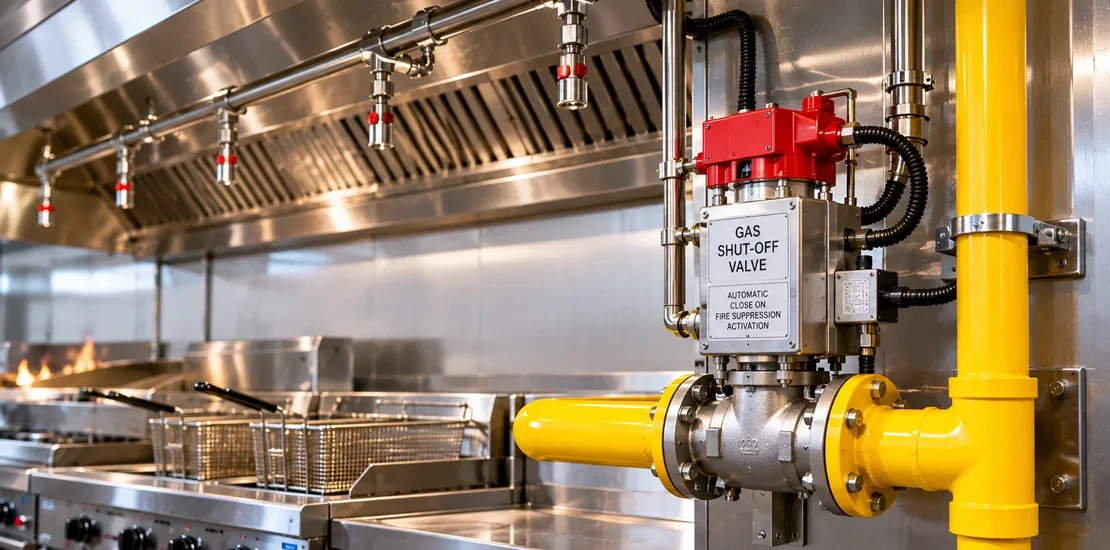
Cutting off the fuel is as important as discharging the agent. If the gas keeps flowing, the fire can restart as soon as the agent is used up. That is why every kitchen fire suppression system connected to gas appliances must include an automatic gas shut-off valve that closes when the system operates and stays closed until it is manually reset.
For kitchens using LPG or natural gas, adding gas detection systems provides an extra layer of safety by detecting leaks before they ignite and closing the gas supply automatically. The two systems complement each other: one prevents gas fires, the other controls fires that do start.
Connecting the System to the Building Fire Alarm
When the kitchen fire suppression system discharges, the building should know immediately. Electrical contacts in the release mechanism send a signal to the fire alarm panel, which can sound the alarm, notify the control room, and trigger other actions such as shutting down make-up air units. With an addressable fire alarm system, the signal appears with its exact location, so the security or management team knows instantly which kitchen is affected, a major advantage in malls and hotels with many food outlets.
Class K Extinguishers: The Essential Backup
A kitchen fire suppression system does not replace portable extinguishers. Every commercial kitchen should also have Class K (Class F) wet chemical extinguishers close to the cooking appliances, so staff can deal with small fires and support the system if needed. Standards such as NFPA 10 commonly require a Class K extinguisher within about 9 meters (30 feet) of cooking appliances using vegetable or animal oils. Our guide on fire extinguisher types explains how to choose and place extinguishers for every area of your facility, including the kitchen.
Kitchen Fire Suppression System Requirements in Saudi Arabia
Commercial kitchens in the Kingdom must meet Civil Defense requirements, which typically expect cooking areas that produce grease-laden vapors to be protected by an approved suppression system, together with suitable extinguishers, safe gas installations, and clean exhaust systems. International standards are widely used as references, including NFPA 96 for ventilation control and fire protection of commercial cooking operations, NFPA 17A for wet chemical systems, and UL 300 for the fire testing of restaurant cooking area systems.
In practice, this means choosing a listed kitchen fire suppression system that is designed for the actual appliances, installed and commissioned by qualified technicians, and supported by a valid maintenance contract. Exact requirements vary by activity and location, so they should always be confirmed for your specific project.
Requirements in Malls and Food Courts
Restaurants inside malls, hotels, and mixed-use developments usually face additional conditions from the building operator. Food court tenants are often required to submit kitchen fire suppression drawings, coordinate their system with the building fire alarm, follow a strict hood and duct cleaning schedule, and provide maintenance certificates before opening and at regular intervals. These conditions protect the entire building, not just one outlet. Our article on safety requirements for malls and commercial centers covers the wider picture for these facilities.
Hood and Duct Cleaning: The Hidden Fire Risk
Grease builds up inside hoods, filters, and ducts with every service. This layer of grease is fuel waiting for a spark. Even the best kitchen fire suppression system works more effectively when the exhaust system is kept clean. Filters should be cleaned frequently, and hoods and ducts should be professionally cleaned at intervals based on the type and volume of cooking. Kitchens with high-volume frying, charbroiling, or wok cooking need more frequent cleaning than kitchens with light cooking.
Kitchen Fire Suppression System for Cloud Kitchens and Small Restaurants
Cloud kitchens, delivery-only brands, and small cafés are growing fast across Saudi Arabia, and many of them operate several cooking lines in a compact space. Owners sometimes assume that a small kitchen does not need a full kitchen fire suppression system, but the fire risk depends on the cooking process, not the size of the restaurant. A single fryer or charbroiler under a hood can start a serious fire. Compact pre-engineered systems are available for small hoods, and shared kitchens with several brands can be protected by one coordinated design that covers every cooking line.
What Affects the Cost of a Kitchen Fire Suppression System?
- The length of the hood and the number of cooking appliances to be protected.
- The type of coverage: appliance-specific or overlapping full-hood coverage.
- The number of agent cylinders and the complexity of the piping.
- Integration with gas shut-off valves, electrical interlocks, and the building fire alarm.
- Requirements from the mall or building operator, including drawings and approvals.
- Maintenance contract scope and recharge costs after discharge.
Comparing offers only by cylinder price can be misleading. A well-designed kitchen fire suppression system that matches your appliances and passes inspection the first time is almost always cheaper than a low-cost system that has to be redesigned.
Kitchen Fire Suppression System Inspection and Maintenance
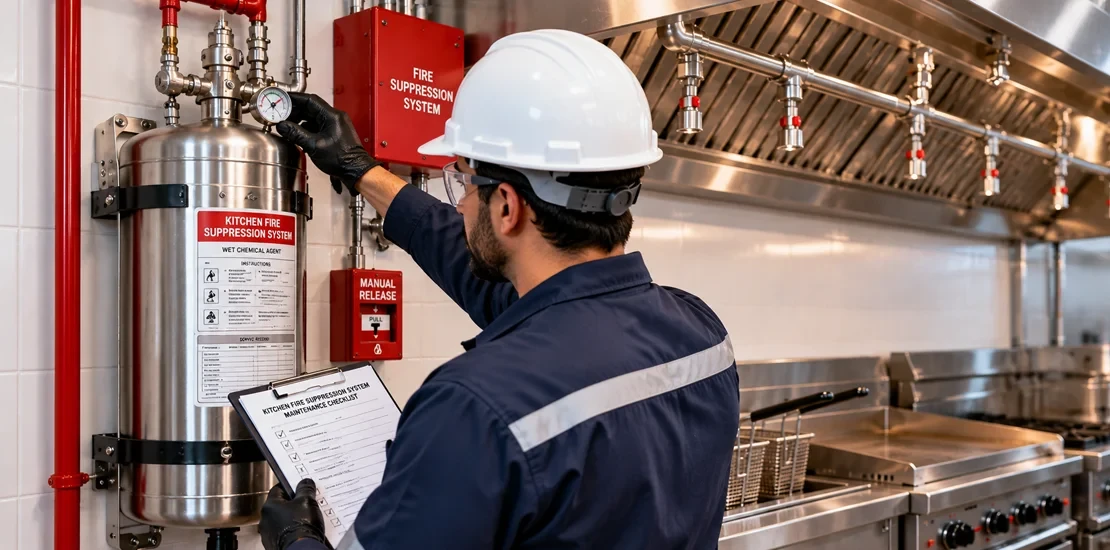
A kitchen fire suppression system must be inspected and serviced regularly by qualified technicians, typically every six months, in line with the manufacturer’s instructions and the applicable standards. Servicing usually includes:
- Checking the agent cylinder, pressure, and weight.
- Inspecting nozzles and replacing blow-off caps that protect them from grease.
- Testing the detection system and replacing fusible links at the required intervals.
- Testing the manual pull station and release mechanism.
- Verifying that the gas shut-off valve and electrical interlocks operate correctly.
- Confirming that nozzle coverage still matches the current appliance layout.
Kitchen staff should also carry out simple daily checks: the pull station is visible and unobstructed, nozzle caps are in place, and the system indicator shows normal. A professional maintenance and support contract ensures every inspection is documented, which is essential for Civil Defense renewals, mall operators, and insurers.
What to Do After the System Discharges
- Evacuate the kitchen and call the fire brigade if the fire is not fully out.
- Do not restart cooking equipment or reopen the gas supply.
- Ventilate the area once it is safe, and avoid touching hot oil.
- Call your service provider to clean the residue, recharge the cylinder, and reset the system.
- Investigate the cause of the fire before resuming operations.
The residue from a kitchen fire suppression system is designed to be cleaned with warm water and detergent, but the system must be recharged and recertified before the kitchen returns to service.
Common Kitchen Fire Suppression System Mistakes
- Moving or adding appliances without updating the system. New fryers or ranges may end up outside the nozzle coverage.
- Skipping semi-annual servicing. Grease-clogged nozzles and old fusible links can stop the system from working.
- Blocking the pull station. Trolleys and stored items often hide the manual release.
- Neglecting duct cleaning. Heavy grease deposits allow fire to spread beyond the protected area.
- Installing unlisted or poorly designed systems. A cheap system that is not tested to recognized standards gives false confidence.
Choosing the Right Kitchen Fire Suppression System Provider
When selecting a provider, look for experience with commercial kitchens of your type and size, systems listed to recognized standards, trained and certified technicians, clear design drawings based on your actual appliances, and the ability to provide installation, commissioning, maintenance, and fast recharging after a discharge. A provider who also understands fire alarms, gas detection, and Civil Defense requirements can coordinate everything as one package and save you time during licensing.
Conclusion
Cooking oil fires start fast, spread into ducts, and cannot be fought safely with water. A kitchen fire suppression system detects these fires automatically, discharges the right agent exactly where it is needed, shuts off the fuel, and alerts the building, all within seconds. Combined with Class K extinguishers, clean exhaust systems, gas safety, and regular maintenance, it gives restaurants and commercial kitchens in Saudi Arabia the protection they need to operate safely and stay compliant.
Opening a new restaurant or upgrading your kitchen? The CCCO team can design, supply, and install a kitchen fire suppression system tailored to your appliances, connect it to your gas and fire alarm systems, and keep it serviced and certified. Contact us today to request a site assessment.
Frequently Asked Questions
What is a kitchen fire suppression system?
It is a pre-engineered system installed in the kitchen hood that detects fires on cooking appliances, discharges a wet chemical agent, and shuts off the fuel supply automatically.
Why can’t water be used on cooking oil fires?
Water turns into steam instantly under hot oil and throws burning oil into the air, which can cause a fireball and spread the fire.
Is a kitchen fire suppression system required in Saudi Arabia?
Commercial kitchens that produce grease-laden vapors are generally expected to have an approved suppression system under Civil Defense requirements. Confirm the exact requirements for your activity.
How often should the system be serviced?
Typically every six months by qualified technicians, following the manufacturer’s instructions and applicable standards.
Does the system shut off the gas automatically?
Yes. A properly installed system includes an automatic gas shut-off valve that closes when the system discharges.
Do I still need extinguishers if I have a suppression system?
Yes. Class K wet chemical extinguishers should be placed near cooking appliances as a backup and for small fires.
What happens after the system discharges?
The kitchen must be cleaned, the cylinder recharged, and the system reset and inspected before cooking resumes.