 Get a Quote

Low Current Systems in Saudi Arabia: A Complete Guide for Commercial Buildings
Low Current Systems in Saudi Arabia: A Complete Guide for Commercial Buildings
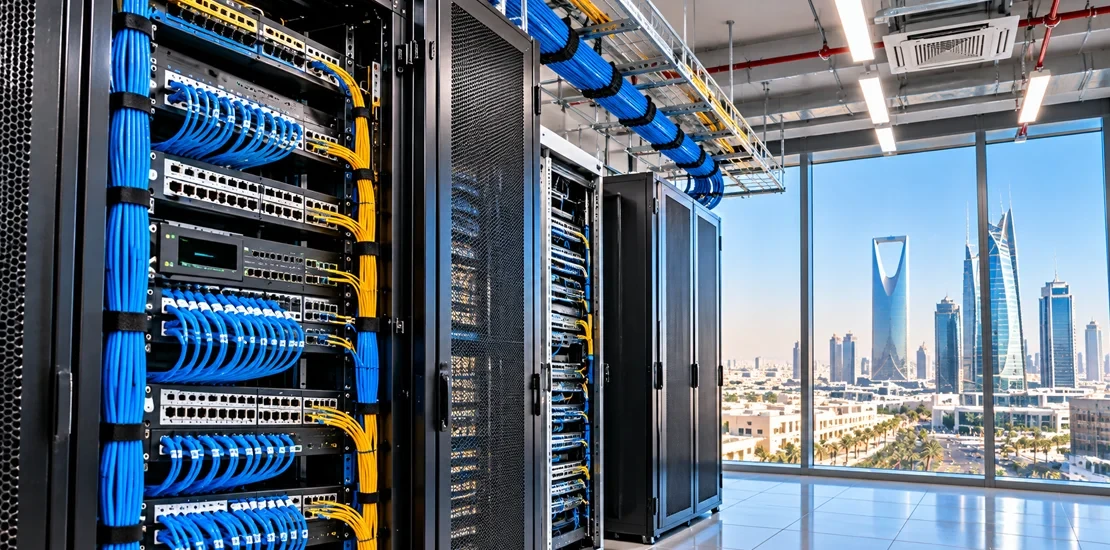
Behind every modern commercial building is a network of systems that most occupants never see but rely on every minute: the fire alarm that warns them, the cameras that protect them, the card reader that lets them in, the network that connects their devices, and the public address system that guides them in an emergency. These are low current systems, and they have become as important to a building’s operation as power, water, and air conditioning.
In Saudi Arabia, the rapid growth of commercial, healthcare, hospitality, and mixed-use projects has made low current systems a central part of building design. This guide explains what low current systems include, how they are designed and installed, the infrastructure they depend on, the approvals and standards involved, and how to keep them reliable throughout the building’s life.
What Are Low Current Systems?
Low current systems, also known as extra low voltage (ELV) or building technology systems, are electrical systems that operate at low voltage and current to carry signals, data, voice, and video rather than to power heavy equipment. They typically run at voltages such as 12V or 24V DC, or are powered over network cables, and they handle the safety, security, communication, and control functions of a building.
Unlike power systems, which are designed around load and capacity, low current systems are designed around coverage, signal quality, reliability, and integration. A small design mistake, such as a missing cable route or poor separation from power cables, can affect an entire system’s performance.
Main Types of Low Current Systems
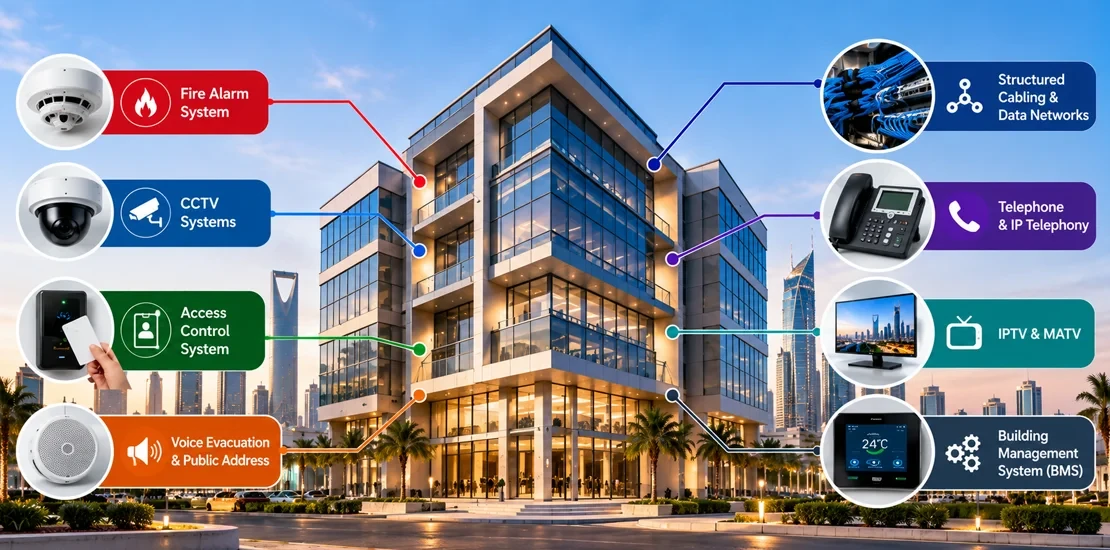
A typical commercial building in Saudi Arabia may include many of the following low current systems:
- Fire alarm system. Detects smoke and heat and warns occupants; an addressable fire alarm system is common in medium and large buildings.
- Voice evacuation and public address. Broadcasts emergency messages and announcements, and often background music in malls and hotels.
- CCTV systems. IP cameras, recorders, and video management software for surveillance and investigation.
- Access control system. Card, mobile, or biometric readers that control entry to doors, gates, and restricted areas.
- Intrusion alarm systems. Motion, door, and glass-break sensors that detect unauthorized entry after hours.
- Structured cabling and data networks. The copper and fiber backbone that carries data, voice, and video for most other systems.
- Telephone and IP telephony. Internal and external voice communication, increasingly running over the data network.
- IPTV and MATV. Television distribution systems for hotels, hospitals, and residential buildings.
- Nurse call systems. Patient-to-staff communication in hospitals and clinics.
- Intercom and video door phones. Visitor communication at entrances, gates, and apartments.
- Parking management systems. Barrier gates, ticketing, license plate recognition, and parking guidance.
- Gas detection systems. Monitoring of flammable or toxic gases in kitchens, car parks, and plant rooms.
- Building management system (BMS). Monitoring and control of HVAC, lighting, pumps, and other building services.
Grouping Low Current Systems by Function
| Category | Systems Included | Main Purpose |
| Life safety | Fire alarm, voice evacuation, gas detection, emergency communication | Protect lives and support safe evacuation |
| Security | CCTV, access control, intrusion alarm, perimeter protection | Protect people, assets, and property |
| Communication | Structured cabling, data network, telephony, Wi-Fi, IPTV | Connect people, devices, and services |
| Building control | BMS, lighting control, energy metering | Improve comfort and reduce energy use |
| Specialized | Nurse call, parking systems, audio-visual, queue management | Serve the specific needs of each building type |
Why Low Current Systems Matter for Commercial Buildings
- Safety and compliance. Fire alarm and voice evacuation systems are essential for Civil Defense approval and occupant safety.
- Cameras, access control, and alarms protect people and assets and support investigations.
- Reliable networks and communication systems keep tenants, staff, and services running smoothly.
- Property value. Well-designed technology infrastructure makes buildings more attractive to tenants and buyers.
- Building management and integrated controls reduce energy use and operating costs.
Low Current Systems by Building Type
The required systems and their priorities change from one building to another. Hospitals need nurse call, voice evacuation, and strict control of restricted areas, while hotels focus on IPTV, communication, and guest room systems. Malls need wide camera coverage, public address, and parking management, and office towers focus on access control, networks, and building management. Designing low current systems should therefore always start from the building’s use and its occupants’ needs, not from a fixed list applied to every project.
The Infrastructure Behind Low Current Systems
All low current systems depend on a solid physical infrastructure. Planning this early is the single most important factor in a successful project:
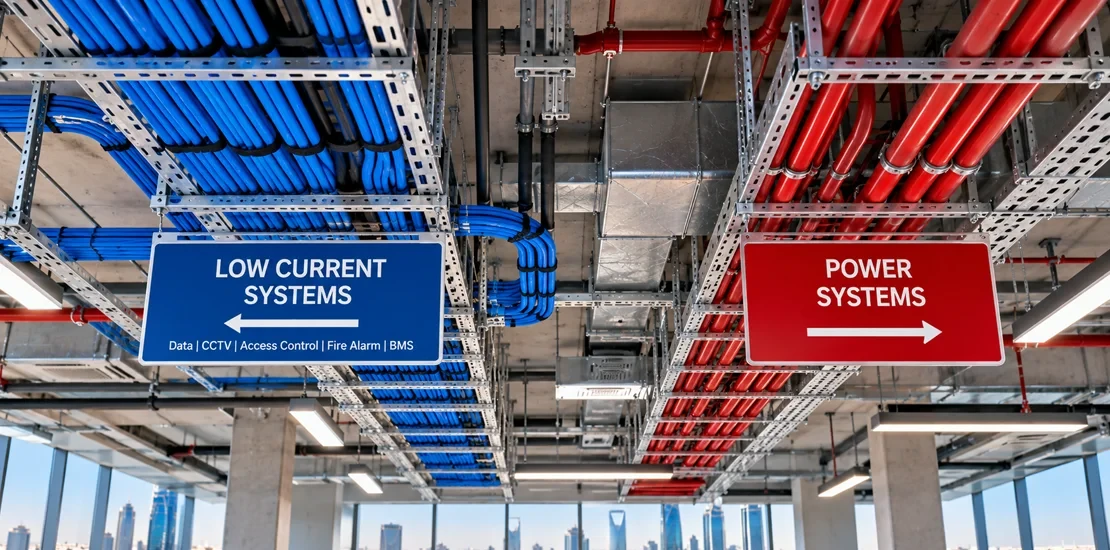
- Cable trays, conduits, and trunking dedicated to low current cables, with enough spare capacity for future additions.
- Separation from power. Low current cables must be separated from power cables by the required distance or by barriers to avoid electromagnetic interference.
- Telecom rooms. A main distribution room (MDF) and floor distribution rooms (IDF) with adequate space, cooling, power, and access control.
- Cable types. Category 6 or 6A copper for most devices, fiber optic for the backbone and long runs, and fire-resistant cables for fire alarm and voice evacuation circuits.
- Power and backup. Dedicated power supplies, UPS units, and battery backup for critical systems.
- Earthing and bonding. Proper earthing of racks, cabinets, and equipment protects people and devices and reduces noise.
Wired, Wireless, and IP-Based Systems
Many low current systems are now IP-based, sharing a converged network instead of running separate cabling for every system. This reduces cabling, simplifies integration, and allows remote management, but it also requires careful network design, segmentation, and cybersecurity. Wireless devices can help in existing buildings or hard-to-reach areas, while wired connections remain the preferred choice for life safety and critical security functions. Our guide on wired vs wireless alarm systems explains these trade-offs in more detail.
How Low Current Systems Are Designed
- Understand the building and its users. Define the building type, occupancy, operating hours, and the client’s security and technology requirements.
- Coordinate early with architects and MEP engineers. Reserve space for telecom rooms, risers, ceiling routes, and equipment before the design is frozen.
- Prepare system designs and specifications. Define device locations, coverage, cable routes, and performance requirements for each system.
- Plan integration. Decide which systems must exchange data, such as fire alarm with access control and elevators, or CCTV with access control.
- Prepare shop drawings and obtain approvals. Submit detailed drawings and material data for review by the consultant and the relevant authorities.
Coordinating low current systems with other trades at the design stage prevents the most common site problems: clashes with ducts and pipes, missing containment, and late changes that increase cost.
Installation, Testing, and Commissioning
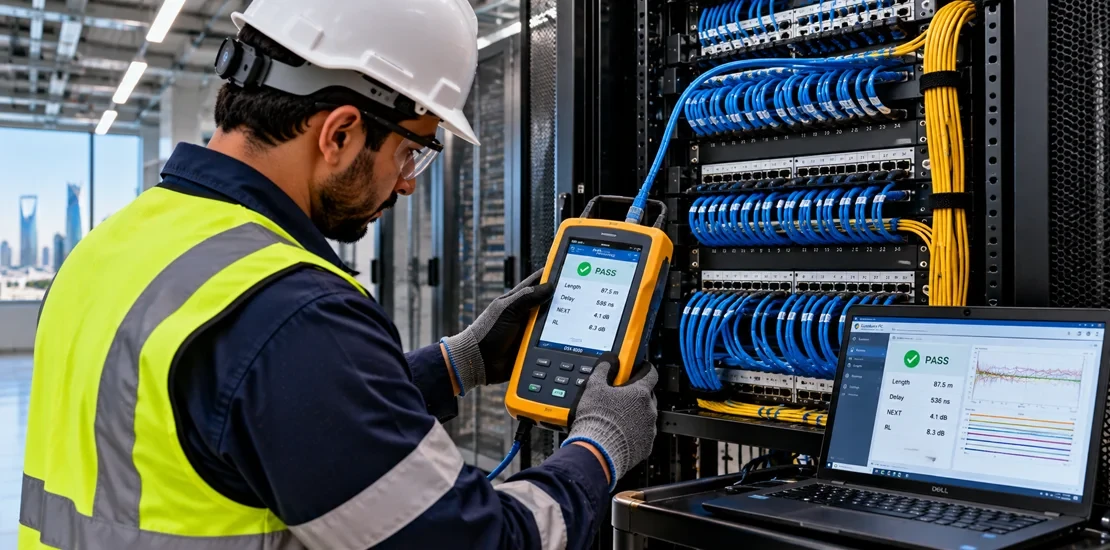
During construction, low current systems are installed in stages: containment first, then cable pulling, followed by device installation, terminations, and labeling. Each cable should be tested and certified, especially structured cabling and fiber links. After installation, each system is commissioned and tested on its own, and then integration tests confirm that systems work together as designed, for example that a fire alarm releases access-controlled doors and recalls elevators.
At handover, the client should receive as-built drawings, test reports, device lists, configuration backups, operation and maintenance manuals, and training for the facility team.
Approvals and Standards in Saudi Arabia
Low current systems in the Kingdom must comply with several requirements. Fire alarm and voice evacuation systems must meet the Saudi Building Code (SBC 801) and Civil Defense requirements, which draw on international standards such as NFPA 72. Telecom infrastructure in buildings should follow the requirements of the Communications, Space and Technology Commission (CST) where applicable, and structured cabling is commonly designed to international standards such as TIA/EIA and ISO/IEC 11801. Security camera installations must also respect the regulations governing the use of security surveillance cameras. Working with an experienced contractor helps ensure designs and installations are approved without delays.
Integration: Making Low Current Systems Work Together
The real value of low current systems appears when they share information. A fire alarm can release doors and display the relevant cameras. A forced door can trigger video recording and an alert in the control room. Parking, access, and visitor systems can share user data. When these functions are managed from one platform, they become integrated security systems that give operators a complete picture of the building and allow faster, more coordinated responses.
Low Current Systems and Saudi Arabia’s Climate
Heat and dust affect low current equipment, especially in telecom rooms, rooftop equipment, outdoor cameras, and gate systems. Telecom rooms need reliable cooling, since overheating shortens the life of switches, recorders, and UPS batteries. Outdoor devices should have suitable temperature ratings, sunshades, and dust-resistant enclosures. Planning for these conditions at the design stage prevents frequent failures and costly replacements later.
Factors That Affect the Cost of Low Current Systems
- The building size, type, and number of floors and zones.
- The number of systems required and the number of devices in each.
- The choice between separate networks and a converged IP network.
- Equipment brands, certifications, and software licenses.
- The level of integration and control room requirements.
- Containment, cabling, and civil works, especially in existing buildings.
- Testing, commissioning, training, and maintenance contracts.
Maintaining Low Current Systems
Once the building is occupied, low current systems need regular care to remain reliable. Maintenance typically includes testing fire alarm and voice evacuation systems, cleaning and checking cameras, verifying access control and alarm devices, updating firmware and software, checking UPS batteries, monitoring network health, and keeping documentation up to date. A planned maintenance and support contract ensures faults are found early and repaired quickly, and that systems continue to meet Civil Defense and client requirements.
How to Choose a Low Current Systems Contractor
The contractor’s experience has a direct impact on how well the systems perform after handover. When comparing offers, check the following points:
- Relevant project experience. Look for completed projects of a similar type and size, such as hospitals, malls, or office towers.
- Approvals and certifications. Confirm the company is approved for fire alarm work and that its engineers are certified by the main equipment manufacturers.
- Design and integration capability. The contractor should be able to coordinate with consultants and integrate several systems, not just install devices.
- Local support. Availability of spare parts, trained technicians, and fast response times in your city.
- Clear documentation. Ask for sample test reports, as-built drawings, and handover packages from previous projects.
Common Mistakes to Avoid
- Late involvement of the low current designer. Without early coordination, there may be no space for risers, rooms, or cable routes.
- Insufficient containment. Overfilled trays and missing conduits make future additions difficult and expensive.
- Poor separation from power cables. Interference can cause unreliable signals and false alarms.
- Ignoring cybersecurity. IP-based systems on unsecured networks can be accessed or disrupted.
- Incomplete documentation. Without labeling and as-built drawings, troubleshooting becomes slow and costly.
Conclusion
Low current systems are the nervous system of every modern commercial building, covering safety, security, communication, and building control. By planning the infrastructure early, choosing suitable technologies, coordinating with other trades, obtaining the right approvals, integrating systems where it adds value, and maintaining them properly, building owners in Saudi Arabia can ensure their low current systems remain reliable, compliant, and ready for future needs.
Planning low current systems for your building? The CCCO team can design, supply, install, and integrate fire alarm, security, and communication systems, coordinate with your consultants and contractors, and provide ongoing maintenance. Contact us to discuss your project.
Frequently Asked Questions
What are low current systems?
They are low voltage systems that carry signals, data, voice, and video for safety, security, communication, and control, such as fire alarms, CCTV, access control, and data networks.
What is the difference between low current systems and ELV systems?
The terms are generally used for the same group of building systems. Low current is common in the Middle East, while ELV (extra low voltage) is widely used internationally.
Which low current systems are required in commercial buildings?
Requirements depend on the building type and use, but fire alarm and often voice evacuation systems are required by Civil Defense, while security and communication systems depend on the owner’s needs.
When should low current systems be designed?
As early as possible, ideally during the concept and design stages, so space, containment, and power can be coordinated with other building services.
Can low current systems share one network?
Many IP-based systems can share a converged network with proper segmentation and security, while some life safety systems may still need dedicated wiring.
Do low current systems need approval in Saudi Arabia?
Yes. Fire alarm and related life safety systems require Civil Defense approval, and other systems may need to follow telecom and surveillance regulations.
How often should low current systems be maintained?
They need planned preventive maintenance according to each system’s requirements, the manufacturer’s guidance, and the building’s maintenance contract.