 Get a Quote

Fire Extinguisher Types: How to Choose and Place Extinguishers in Commercial Facilities
Fire Extinguisher Types: How to Choose and Place Extinguishers in Commercial Facilities
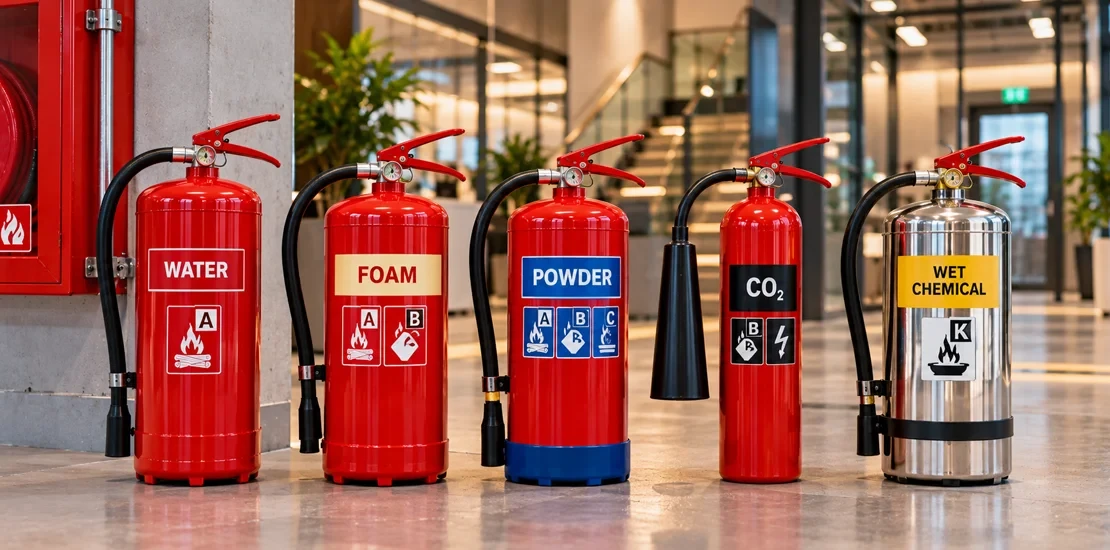
In the first minutes of a fire, a portable extinguisher in the right hands can stop a small flame from becoming a disaster. But the wrong extinguisher can do the opposite. Water on a cooking oil fire can cause a violent flare-up, and water on live electrical equipment can put the user at risk of electric shock. That is why understanding fire extinguisher types is not a technical detail for specialists only. It is essential knowledge for every facility manager, business owner, and safety officer.
This guide explains the main fire extinguisher types, the classes of fire each one is designed to fight, how to choose the right extinguisher for every area of your facility, where and how to place them, and how to keep them ready. By the end, you will know exactly what your building needs and why.
Why Choosing the Right Extinguisher Matters
Fire extinguishers are usually the first firefighting equipment people reach for. When the type matches the fire, a trained person can often control the fire before it spreads. When the type does not match, the extinguisher may be ineffective or even dangerous.
Choosing the right fire extinguisher types is also a regulatory matter. Missing, wrong, or poorly maintained extinguishers are among the most common findings during inspections and a frequent reason for delays in obtaining a civil defense safety license. Getting this right is one of the simplest and most affordable ways to improve safety and compliance at the same time.
Understanding Fire Classes Before Comparing Fire Extinguisher Types
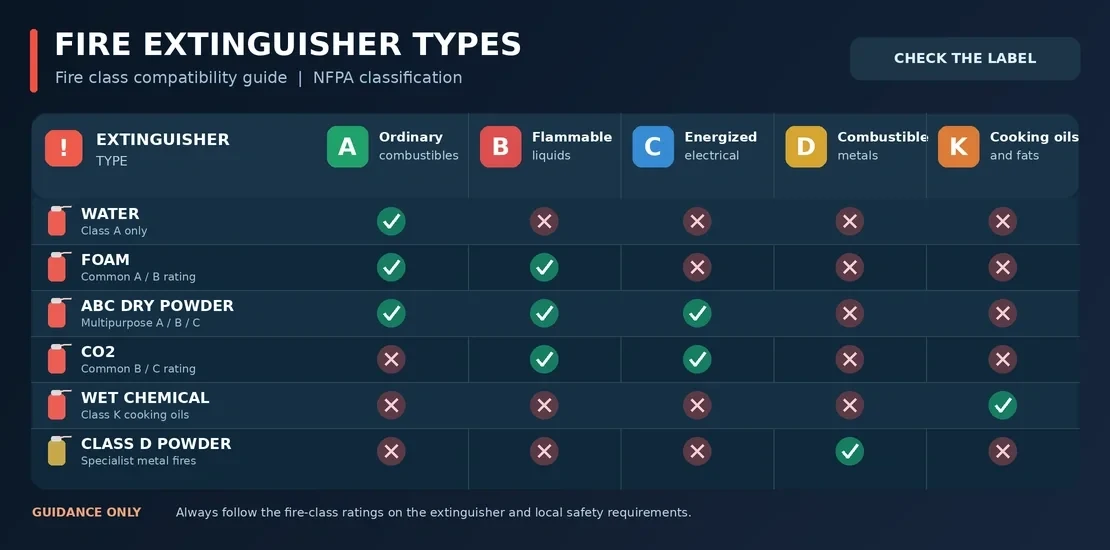
All fire extinguisher types are designed for specific classes of fire. Two classification systems are widely used: the American system (NFPA) and the European/international system (EN/ISO). Many products sold in Saudi Arabia carry labels from one of these systems, so it helps to understand both:
| Fuel Type | American Class (NFPA) | European Class (EN) |
| Ordinary combustibles: wood, paper, fabric, plastics | Class A | Class A |
| Flammable liquids: petrol, diesel, solvents, paints | Class B | Class B |
| Flammable gases: LPG, natural gas | Class B | Class C |
| Energized electrical equipment | Class C | No separate class (electrical risk) |
| Combustible metals: magnesium, sodium, lithium metal | Class D | Class D |
| Cooking oils and fats | Class K | Class F |
The most important rule when comparing fire extinguisher types is simple: always read the label. A reliable extinguisher clearly shows the fire classes it is approved for and how to use it.
The Main Fire Extinguisher Types
Below are the most common fire extinguisher types found in commercial buildings, with their strengths and limitations.
Water Extinguishers
Water extinguishers are the simplest of all fire extinguisher types. They cool burning materials and are effective on Class A fires involving wood, paper, textiles, and many plastics. They are simple and economical, which makes them common in offices, schools, and warehouses storing ordinary materials.
However, standard water extinguishers must never be used on flammable liquids, cooking oils, or live electrical equipment. Some water mist and additive-based models carry broader ratings, so the label must always be checked.
Foam Extinguishers (AFFF)
Foam extinguishers are effective on Class A and Class B fires. The foam forms a blanket over burning liquids, cutting off oxygen and preventing re-ignition. They are well suited to garages, workshops, fuel storage areas, and facilities that handle flammable liquids. Standard foam extinguishers are not suitable for cooking oil fires or energized electrical equipment unless the label states otherwise.
Dry Chemical Powder Extinguishers
Dry powder extinguishers are among the most widely used fire extinguisher types because of their versatility. ABC powder (multipurpose) can handle Class A, B, and C fires, and is commonly used on electrical fires as well. They are effective in shops, vehicles, warehouses, and general areas.
The trade-off is the residue. Powder spreads widely, reduces visibility in enclosed spaces, and can damage sensitive electronics and machinery. For server rooms, control rooms, and laboratories, cleaner alternatives are usually preferred.
Carbon Dioxide (CO2) Extinguishers
Among fire extinguisher types used for electrical risks, CO2 extinguishers are the most common. They displace oxygen and cool the fire without leaving any residue. They are the standard choice for electrical risks such as distribution panels, server racks, and offices with many computers, and they are also effective on small flammable liquid fires.
CO2 has limited effect on deep-seated Class A fires, and the discharge horn becomes extremely cold, so users must hold the extinguisher by the handle only. In small enclosed rooms, CO2 can reduce oxygen levels, so users should leave the area after discharge.
Wet Chemical Extinguishers
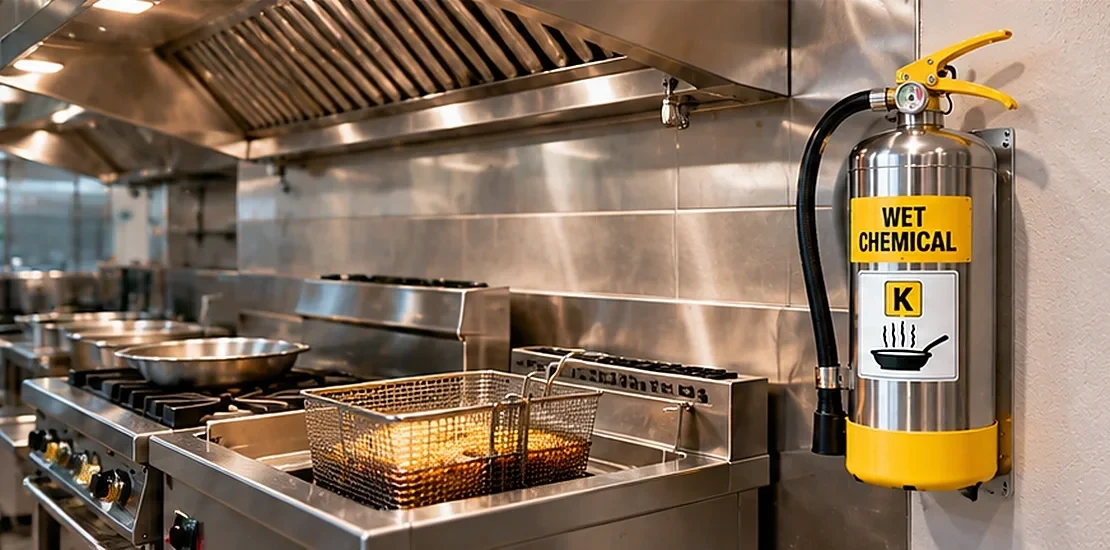
Wet chemical extinguishers are the fire extinguisher types designed specifically for cooking oil and fat fires (Class K / Class F). They cool the oil and create a soap-like layer on the surface that prevents re-ignition. Every commercial kitchen, restaurant, and food court should have them near deep fryers and cooking ranges, alongside a kitchen fire suppression system installed over the cooking appliances.
Clean Agent Extinguishers
Clean agent extinguishers use gaseous agents that leave no residue and are safe for sensitive equipment. They suit data centers, telecom rooms, laboratories, museums, and control rooms where powder or water would cause expensive damage. They generally cost more than other fire extinguisher types, but they protect assets that are far more valuable.
Specialist Class D Powder Extinguishers
Of all fire extinguisher types, Class D units are the most specialized. Combustible metals such as magnesium, titanium, and sodium require special Class D powder. Ordinary extinguishers can make metal fires worse. These are needed in specific industrial settings, such as metalworking facilities and some laboratories.
Fire Extinguisher Types at a Glance
| Type | Suitable For | Not Suitable For | Typical Locations |
| Water | Class A | Flammable liquids, cooking oils, live electrical | Offices, schools, general storage |
| Foam (AFFF) | Class A, B | Cooking oils, live electrical (unless rated) | Garages, workshops, fuel areas |
| ABC powder | Class A, B, C and electrical | Sensitive electronics (residue) | Shops, warehouses, vehicles, general areas |
| CO2 | Class B and electrical | Deep-seated Class A, small closed rooms | Electrical panels, server racks, offices |
| Wet chemical | Class K / F, also Class A | Electrical (unless rated) | Commercial kitchens, restaurants |
| Clean agent | Class A, B, electrical | Large open areas (limited reach) | Data centers, control rooms, labs |
| Class D powder | Combustible metals | General fires | Metalworking, special labs |
How to Choose Fire Extinguisher Types for Each Area
The best approach is to match fire extinguisher types to the actual risks in each area rather than placing the same model everywhere. A fire risk assessment identifies the materials, equipment, and activities in every zone and guides the selection. Practical examples include:
- Offices and meeting rooms: water or foam for paper and furniture, plus CO2 near electrical equipment and server cabinets.
- Retail shops: ABC powder or foam for general areas, with CO2 near electrical panels.
- Restaurants and kitchens: wet chemical near cooking equipment, plus CO2 or powder for electrical risks.
- Warehouses: ABC powder and wheeled units for large open areas and high fire loads.
- Server and electrical rooms: CO2 or clean agent to avoid damaging equipment.
- Workshops and garages: foam or ABC powder for fuels and oils.
- Clinics and laboratories: CO2 or clean agent for equipment, with specialist units where chemicals or metals are used.
Placement Rules for All Fire Extinguisher Types
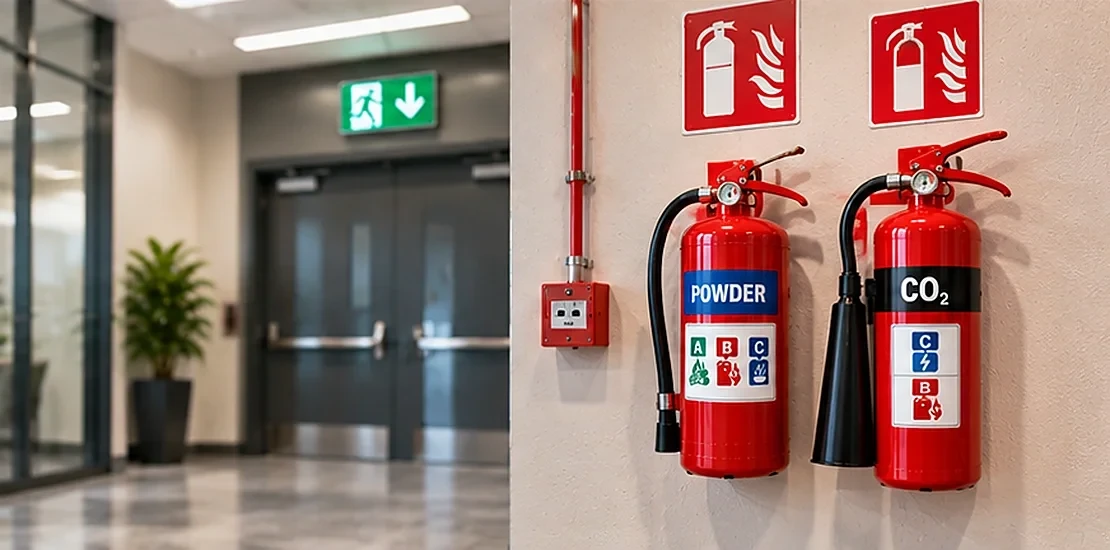
Even the right fire extinguisher types are useless if no one can reach them quickly. Good placement follows a few practical principles commonly based on standards such as NFPA 10 and local Civil Defense requirements:
- Near exits and escape routes. People should be able to grab an extinguisher on their way out, without moving toward the fire.
- Close to the specific risk. Wet chemical near fryers, CO2 near electrical panels, and foam near fuel storage.
- Limited travel distance. NFPA 10 commonly limits travel distance to a Class A extinguisher to about 23 meters (75 feet), with shorter distances for Class B and kitchen risks. Your local requirements define the exact distances for your facility.
- Correct mounting height. Extinguishers should be mounted on brackets or placed in cabinets so the handle is easy to reach, generally not higher than about 1.5 meters for standard units, and kept off the floor.
- Clear visibility and signage. Each location should be marked with a sign visible from a distance and never hidden behind goods, doors, or decorations.
- Protected from damage and weather. Outdoor units need cabinets or covers to protect them from sun, dust, and impact.
Fire Extinguisher Types: Sizes and Capacities
Extinguishers come in different sizes, commonly from 1 to 12 kilograms for portable powder units and 2 to 5 kilograms for portable CO2 units, with larger wheeled units for high-risk areas. Bigger is not always better: a heavy extinguisher is harder for some staff to carry and use. The right size depends on the fire risk, the size of the area, and the people expected to use it. Many facilities combine standard portable units with a few larger wheeled extinguishers in warehouses, loading areas, and plant rooms.
How to Use a Fire Extinguisher: The PASS Method
Training staff is just as important as choosing the right fire extinguisher types. The PASS method is easy to remember:
- Pull the safety pin.
- Aim the nozzle at the base of the fire, not at the flames.
- Squeeze the handle to discharge the agent.
- Sweep from side to side across the base of the fire until it is out.
Staff should only attempt to fight small fires, always keep an escape route behind them, and evacuate immediately if the fire grows or the extinguisher runs out.
Keeping Extinguishers Ready: Inspection and Maintenance
Whatever fire extinguisher types you install, an extinguisher that has lost pressure or has a damaged hose provides false confidence. Regular checks should confirm that each unit is in its place, visible, accessible, pressurized, sealed, undamaged, and carries a valid service tag. Our fire system inspection checklist covers these items in detail.
Beyond monthly visual checks, extinguishers require annual servicing by qualified technicians, refilling after any use, and periodic pressure testing of cylinders at the intervals set by the applicable standards. Including extinguishers in your periodic maintenance schedule and a professional maintenance and support contract ensures nothing is missed and your records are ready for every inspection.
Fire Extinguisher Types and Saudi Arabia’s Climate
Heat and dust affect extinguishers more than many facility managers expect. Units installed outdoors, on rooftops, in vehicles, or near windows can be exposed to high temperatures that stress seals and affect pressure. Dust can block nozzles and hide pressure gauges. When selecting fire extinguisher types for outdoor areas, fuel stations, loading docks, and parking areas, choose models rated for high ambient temperatures, install them in protective cabinets out of direct sunlight, and check them more often during the summer months.
Buying Quality Extinguishers
Not all extinguishers on the market offer the same reliability. Choose certified products that comply with Saudi standards and are accepted by Civil Defense, with clear labels showing the fire classes, rating, and operating instructions in Arabic and English. Buy from suppliers who can also provide installation, servicing, and refilling, so the same team that understands your fire extinguisher types and locations keeps them ready over time. Very cheap units often cost more in the long run due to failures, leaks, and early replacement.
Common Mistakes with Fire Extinguisher Types
- Using one extinguisher type everywhere. A single model rarely covers every risk, so most facilities need several fire extinguisher types.
- Placing water extinguishers near electrical panels or kitchens. This creates a serious hazard.
- Blocking access. Goods, furniture, or locked rooms make extinguishers useless in an emergency.
- Ignoring expired service tags. Out-of-date extinguishers are a common inspection finding.
- No staff training. People who have never used an extinguisher often hesitate or use it incorrectly.
- Not refilling after use. Even a partially used extinguisher must be recharged.
Extinguishers Are the First Line, Not the Only Line
Portable extinguishers are designed for small fires in their early stages. Larger buildings and higher-risk facilities also need fire alarms, sprinklers, hose reels, and specialized suppression systems that work automatically or support firefighters. The right fire extinguisher types work best as part of a complete fire protection strategy that includes properly designed firefighting systems.
Conclusion
Understanding fire extinguisher types helps you protect people and property with the right tool for every risk. By matching each extinguisher to the fire class in its area, placing units where people can reach them quickly, training staff to use them correctly, and maintaining them regularly, your facility will be ready to stop small fires before they become emergencies, and ready for every Civil Defense inspection.
Not sure which fire extinguisher types your facility needs? The CCCO team can assess your site, recommend the right extinguishers for every area, supply and install them correctly, and keep them inspected and serviced throughout the year. Contact us today to request a site assessment.
Frequently Asked Questions
What are the main fire extinguisher types?
The main types are water, foam, dry chemical powder, carbon dioxide (CO2), wet chemical, clean agent, and specialist Class D powder extinguishers.
Which extinguisher is best for electrical fires?
CO2 and clean agent extinguishers are preferred for electrical equipment because they leave no residue. ABC powder is also effective but can damage sensitive electronics.
Which extinguisher should be used in a kitchen?
Wet chemical extinguishers are designed for cooking oil and fat fires and should be placed near fryers and cooking ranges.
Can one extinguisher type cover all risks?
No single type is ideal for every risk. Most facilities need a combination of fire extinguisher types based on the materials and equipment in each area.
How far apart should extinguishers be placed?
Travel distance depends on the fire risk and applicable standards. NFPA 10 commonly limits Class A travel distance to about 23 meters, with shorter distances for higher risks.
How often should fire extinguishers be inspected?
They should be checked visually on a regular basis, typically monthly, and serviced annually by qualified technicians, with periodic cylinder testing as required.
Do fire extinguishers need to be refilled after partial use?
Yes. Any extinguisher that has been discharged, even partially, must be recharged or replaced immediately.